
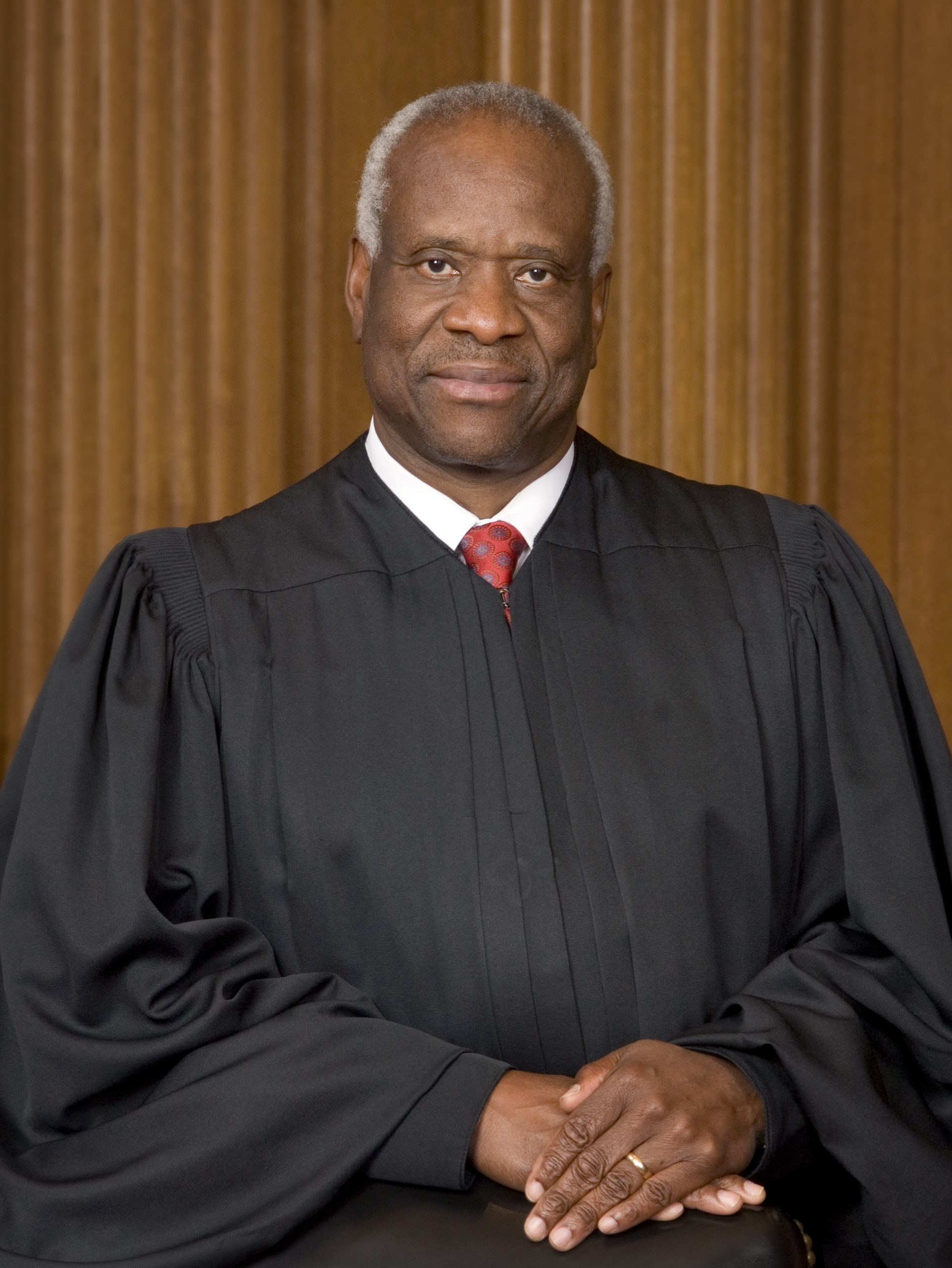
Clarence Thomas is an associate justice of the United States Supreme Court whose service began on October 23, 1991. His professional background includes state government, corporate law, congressional work, civil rights administration and the federal appeals court. By November 24, 2026, he had served on the Supreme Court for more than 35 years.
Thomas’s biography is closely connected with debates about constitutional interpretation. His written opinions address issues ranging from free speech and religious expression to firearms and the structure of federal agencies. Understanding his contribution requires distinguishing opinions he writes for the Court from separate opinions expressing his own position.
Clarence Thomas biography at a glance
| Detail | Information |
|---|---|
| Born | June 23, 1948 |
| Birthplace | Pinpoint community near Savannah, Georgia |
| Age | 78 as of November 24, 2026 |
| Undergraduate degree | College of the Holy Cross, 1971 |
| Law degree | Yale Law School, 1974 |
| EEOC chairmanship | May 6, 1982–March 8, 1990 |
| Supreme Court service | Since October 23, 1991 |
Education and the beginning of his legal career
The Supreme Court’s official biography records Thomas’s birth in the Pinpoint community and his attendance at Conception Seminary in 1967–1968. He subsequently graduated from Holy Cross in 1971 and Yale Law School in 1974. His path therefore included a change from seminary study to undergraduate education and then professional legal training.
His first legal appointment was as an assistant attorney general in Missouri. He later worked as an attorney for Monsanto and as a legislative assistant to Senator John Danforth. These positions exposed him to different settings in which law operates: a state government office, a private corporation and the legislative branch.
The sequence is useful context for his later judicial career. Thomas did not move directly from law school to the Supreme Court. His experience included applying and administering law before he became responsible for deciding cases on a federal appellate court.
Civil rights administration and the EEOC
Thomas served as assistant secretary for civil rights at the Department of Education before becoming chairman of the Equal Employment Opportunity Commission. The EEOC’s historical record dates his chairmanship precisely: May 6, 1982, to March 8, 1990. President Ronald Reagan appointed him to that leadership position.
The commission’s official overview explains its responsibility for enforcing federal laws against employment discrimination. Its work concerns applicants and employees and includes discrimination involving protected characteristics such as race, religion, sex, national origin, age and disability. Its responsibilities also include guidance and work relating to federal agencies.
Leading such an agency is an administrative responsibility, distinct from sitting as a judge. The agency operates within legislation and enforcement processes; a court resolves the legal disputes presented to it. This distinction matters when examining Thomas’s movement from executive branch service into the federal judiciary.
His EEOC period occupied much of the 1980s. It remains a substantial part of his professional record even though his much longer Supreme Court service now dominates public discussion of his work.
Appointment to the Supreme Court
After serving on the U.S. Court of Appeals for the District of Columbia Circuit, Thomas was nominated to the Supreme Court by President George H.W. Bush. The Senate’s historical nominations table records his nomination and confirmation in 1991.
The official roll call shows a 52–48 confirmation vote on October 15. He took his seat on October 23. The vote date and the beginning of service are separate milestones, a small but important distinction in a precise account of his tenure.
His appointment began a judicial career spanning changes in the Court’s membership, national politics and the disputes arriving from lower courts. Long service gives an individual justice many opportunities to write, but the authority of a particular opinion still depends on the case and on how many other justices join its reasoning.
Selected career and opinion timeline
| Date | Milestone | Context |
|---|---|---|
| 1974 | Legal career began in Missouri | State government practice |
| 1982–1990 | EEOC chairman | Federal employment discrimination agency |
| 1990–1991 | D.C. Circuit judge | Federal appellate service |
| October 1991 | Supreme Court confirmation and service | Associate justice appointment |
| 2001 | Good News Club opinion | Religious expression and school facilities |
| 2022 | Bruen opinion | Firearm licensing and constitutional interpretation |
| 2024 | CFPB funding opinion | Congressional appropriations authority |
| November 2026 | Khatibi dissent from denial of review | Government speech and medical education |
Free speech: Good News Club v. Milford Central School
Thomas wrote the Court’s opinion in Good News Club v. Milford Central School, decided June 11, 2001. The case concerned a private Christian children’s organization that sought to meet after school in facilities available for certain community activities.
The dispute asked whether excluding the club violated its free speech rights and whether the school’s concern about the Establishment Clause justified the exclusion. The Court concluded that the restriction violated the club’s speech rights and that the stated Establishment Clause concern did not justify it.
This decision illustrates how a case involving religion can also involve the rules governing access to a public forum. The legal question was not simply whether religious activity existed, but how a school treated a private group within the facilities-use arrangement it had established. For Thomas’s biography, the case provides a concrete example of his work on First Amendment questions.
Bruen and the use of constitutional history
In New York State Rifle & Pistol Association v. Bruen, decided June 23, 2022, Thomas delivered the Court’s opinion addressing New York’s requirement that applicants show a special need to obtain certain public-carry firearm licences.
The decision rejected that proper-cause requirement and emphasized constitutional text and historical tradition in evaluating firearm regulation. That method is a clear example of the importance Thomas assigns to historical constitutional meaning.
The opinion’s relevance to his career extends beyond the particular licensing dispute. It demonstrates how a justice’s interpretive method can shape the framework lower courts use in later litigation. The boundaries and application of that framework remain legal questions addressed through subsequent cases; a biography should not turn a historical case summary into personalised advice about carrying a firearm.
A different subject: the CFPB’s funding structure
Thomas also wrote the majority opinion in Consumer Financial Protection Bureau v. Community Financial Services Association of America, decided May 16, 2024. It concerned whether the bureau’s statutory funding arrangement satisfied the Constitution’s Appropriations Clause.
The Court held that Congress’s authorization allowing the bureau to draw money from Federal Reserve earnings for its duties met that constitutional requirement. The opinion examined the source and designated purpose of the funding and discussed historical appropriations practice.
Including this case gives a broader picture of Thomas’s writing than concentrating only on culturally prominent disputes. His judicial record also encompasses the legal architecture of federal administration. It shows why a political label alone cannot explain the issue, reasoning or coalition in every case.
The November 2026 Khatibi dissent
The Court’s November 16, 2026 order list records denial of review in Khatibi v. Yip, No. 25-1240. Earlier proceedings used the name Khatibi v. Hawkins. The dispute involved California’s implicit-bias content requirement for continuing medical education.
Thomas, joined by Justice Samuel Alito, dissented from the denial. He questioned the treatment of privately delivered educational content as government speech. Justice Neil Gorsuch also indicated that he would grant review.
The procedural outcome must remain clear: the Supreme Court declined to hear the case. Thomas’s separate writing explained why he wanted review; it did not establish a Court ruling invalidating California’s requirement.
How to read his judicial record
The Court’s opinions guide distinguishes the principal opinion from concurrences and dissents. A concurrence may agree with a result while supplying different reasoning. A dissent expresses disagreement. Justices can also write about orders, including decisions not to take a case.
These labels make a real difference to understanding Thomas’s influence. An opinion for the Court and a dissent can both be historically significant, but they do not carry the same legal effect. Reading the document’s heading and procedural disposition is therefore more reliable than relying on a dramatic excerpt alone.
Thomas’s career also spans both sides of federal administration: he once led an agency and later reviewed the constitutional limits on government institutions from the bench. That combination makes administrative structure a meaningful part of his biography alongside the more widely discussed disputes about individual rights.
Frequently asked questions
How old is Clarence Thomas?
He is 78 as of November 24, 2026. His birth date is June 23, 1948.
Where was Clarence Thomas born?
He was born in the Pinpoint community near Savannah, Georgia.
Where did he study law?
He earned his law degree at Yale in 1974 after graduating from Holy Cross in 1971.
Who nominated him to the Supreme Court?
President George H.W. Bush nominated him. The Senate confirmed him in October 1991.
When did his Supreme Court service begin?
He took his seat on October 23, 1991, after the October 15 confirmation vote.
Did his Khatibi dissent strike down a California rule?
No. It was a dissent from denial of review. The Court declined to hear the case.
Where can readers find his opinions?
The Supreme Court publishes opinions and order lists. The document identifies whether he writes for the Court or separately.

Thomas Andrew is the founder of Odubio.com, a digital platform sharing inspiring biographies, news, and stories about global icons and achievers.