
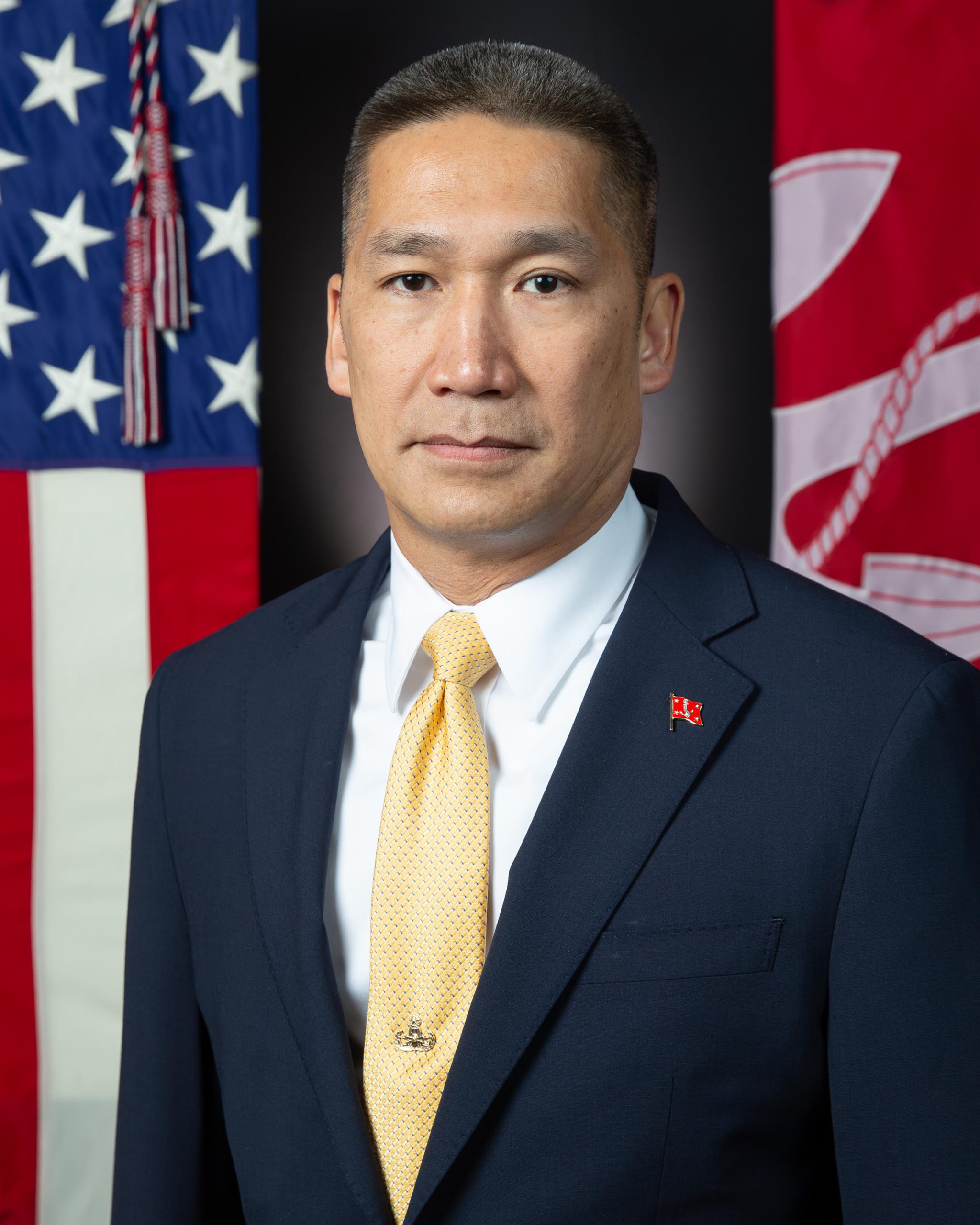
Hung Cao is a retired U.S. Navy captain and acting secretary of the Navy whose career spans diving, explosive ordnance disposal, defense technology and Republican electoral politics in Virginia. He assumed the acting secretary’s responsibilities on April 22, 2026, after serving as under secretary of the Navy.
As of November 24, 2026, he is also a nominee for the permanent secretary position. The Senate Armed Services Committee held his confirmation hearing on November 17, but a hearing is not the same as final Senate confirmation. The acting title is therefore retained in this updated biography.
Hung Cao biography at a glance
| Detail | Verified information |
|---|---|
| Current role | Acting secretary of the Navy |
| Acting service began | April 22, 2026 |
| Military background | Retired Navy captain; diving and explosive ordnance disposal |
| Naval Academy class | 1996 |
| Education | Bachelor’s degree in ocean engineering; master’s degree in applied physics |
| Retirement from active duty | October 2021 |
| Virginia campaigns | U.S. House in 2022 and U.S. Senate in 2024 |
| Permanent appointment | Nomination under Senate consideration at this update |
From Vietnam to Northern Virginia
Cao arrived in the United States as a Vietnamese refugee in 1975. His family subsequently lived in West Africa before returning to Northern Virginia when he was 12. The U.S. Naval Academy’s official biography records that international childhood and his later graduation with the inaugural class of Thomas Jefferson High School for Science and Technology.
In his November 2026 statement to the Armed Services Committee, Cao described the role of sailors and Marines in his family’s refugee experience. He presented those memories as part of his motivation to serve in the military. That account is his own explanation of the personal experiences behind the career.
The movement between countries is a significant part of the chronology. His biography is not simply a sequence from arriving in America to entering the Naval Academy. It includes years abroad, a return to Virginia and a technical secondary education before his military career developed.
Enlistment, the Naval Academy and technical study
Cao entered the Navy as a seaman recruit in 1989. He later attended the United States Naval Academy and was commissioned as a special operations officer in 1996. His path thus included enlisted service before commissioning, rather than beginning solely with an officer appointment.
His qualifications include a bachelor’s degree in ocean engineering and a master’s degree in applied physics. The academy also records participation as a fellow with MIT Seminar XXI and Harvard Kennedy School. Fellowships should be distinguished from the two degrees: they are additional professional educational experiences, not evidence of extra academic degrees.
The technical fields fit the operational career that followed. Ocean engineering concerns systems functioning in a marine environment; applied physics connects physical principles with practical problems. Neither degree alone summarizes his service, but together they provide context for work involving underwater operations, explosives and specialized technology.
The academy’s record also identifies French and Vietnamese language fluency. Those details connect with his international background, though a language qualification should not be used to infer an undocumented posting or assignment.
Diving and explosive ordnance disposal
As a Navy diver, Cao led underwater missions. As an explosive ordnance disposal officer, he led counter-improvised-threat missions supporting special warfare and special forces, with deployments to Iraq, Afghanistan and Somalia, according to the official service biography.
These are specialized areas of military work. Diving involves operating in an environment where equipment, training and coordination are fundamental. Explosive ordnance disposal concerns identifying and addressing explosive hazards, including threats encountered during military operations.
It is important to describe the qualifications actually documented. Serving with or supporting special warfare units does not automatically make every supporting officer a Navy SEAL. Cao’s biography specifically identifies special operations, EOD and diving qualifications, along with naval parachutist and surface warfare qualifications.
In his final active-duty tour, the academy says he led sensitive activities, exploitation, counter-messaging and counter-drone operations supporting combatant commanders and Special Operations Command. He retired in October 2021 with the rank of captain. That retirement date separates his uniformed career from later private-sector, political and civilian appointments.
Defense technology after active duty
Before his civilian Navy appointment, Cao worked as a vice president and client executive at CACI International. The official biography describes involvement in fielding technologies including electronic warfare packages, counter-drone systems, optical communications, photonics, enterprise information technology and shipyard infrastructure optimization.
The range shows a connection between operational experience and the systems used to support naval activity. Counter-drone technology addresses a different problem from shipyard planning, but both can form part of a wider effort to maintain and equip military forces.
A private-sector defense role should remain distinct from a government office. An executive works within a company’s responsibilities and contracts; a civilian Navy official has public authority and oversight obligations. Cao’s career includes both settings, and the transition between them is part of the professional record.
Virginia elections in 2022 and 2024
Cao sought a U.S. House seat in Virginia’s 10th Congressional District in 2022 but lost to Democratic incumbent Jennifer Wexton. He later became the Republican nominee for the U.S. Senate in 2024, challenging Senator Tim Kaine.
Virginia’s official historical election record identifies the 2024 candidates, and Associated Press reporting records Kaine’s reelection. Cao therefore did not enter Congress through either campaign.
The two contests involved different electorates: one congressional district in 2022 and the entire state in 2024. They also preceded his later executive-branch appointment. Military service, election candidacy and Senate-confirmed civilian office are separate forms of public activity; none should be substituted for another in describing his résumé.
Hung Cao career timeline
| Date | Milestone | Context |
|---|---|---|
| 1975 | Arrived in the United States | Vietnamese refugee background |
| 1989 | Entered the Navy | Enlisted as a seaman recruit |
| 1996 | Naval Academy graduation and commissioning | Special operations officer career |
| October 2021 | Retired from active duty | Rank of captain |
| 2022 | House campaign | Virginia’s 10th District |
| 2024 | Senate campaign | Republican challenger to Tim Kaine |
| April 2026 | Acting secretary responsibilities began | After under secretary service |
| November 2026 | Secretary nomination hearing | Permanent appointment under consideration |
Under secretary and acting secretary of the Navy
Cao served as under secretary before assuming the acting secretary’s role. The academy records April 22, 2026, as the beginning of the acting appointment. It also describes his responsibilities as a senior defense official for Guam, including advocacy and support for infrastructure consistent with operational requirements.
The secretary is a civilian leader of the Department of the Navy, a department that includes both the Navy and Marine Corps. The position is different from the uniformed chief of naval operations or the Marine Corps commandant. A retired officer taking a civilian office changes institutional responsibilities as well as title.
That distinction is central to understanding his present role. His earlier operational work forms part of his experience, but a department-wide civilian leader must address personnel, resources, acquisition and oversight across a much broader organization.
The November 2026 confirmation process
The Armed Services Committee hearing page records consideration of Cao’s nomination on November 17, 2026. The Senate’s civilian nominations-in-committee list continues to identify his nomination at this review.
In his prepared statement, Cao identified personnel, shipbuilding and homeland defense as priorities. These were the programme he presented to senators, rather than independent proof that every proposed improvement had already occurred. The hearing allowed lawmakers to examine his record and the department’s needs.
Specialist reporting by USNI News also explained the statutory waiver question arising from his recent active-duty service. That requirement adds a separate issue to the normal Senate confirmation process. Nomination, a hearing and final approval should therefore not be compressed into a single event.
USNI’s report explains that the secretary position normally requires a seven-year interval after active service as a commissioned officer. Cao’s October 2021 retirement falls within that interval in 2026, which is why the waiver issue matters to his nomination. This is a statutory eligibility question separate from whether senators support his policy views or consider his operational background relevant to the department’s work.
At the date of this update, the accurate description remains acting secretary and nominee for the permanent position. Future action should be reflected when a completed official record establishes it, rather than anticipated in advance.
Frequently asked questions
Who is Hung Cao?
He is a retired Navy captain serving as acting secretary of the Navy and nominated for the permanent position.
When did he become acting secretary?
The Naval Academy biography records April 22, 2026, as the date he assumed those responsibilities.
Did Hung Cao attend the Naval Academy?
Yes. He belongs to the class of 1996 and was commissioned after earlier enlisted service.
What did he study?
His documented degrees are in ocean engineering and applied physics. His professional fellowships are separate qualifications.
Did he win a Virginia congressional election?
No. His 2022 House and 2024 Senate campaigns did not result in election to Congress.
Was his November hearing final confirmation?
No. The hearing was part of Senate consideration. This November 24 update retains the acting title.
What was his military specialty?
His official record identifies diving, explosive ordnance disposal and special operations qualifications, with multiple overseas deployments.

Thomas Andrew is the founder of Odubio.com, a digital platform sharing inspiring biographies, news, and stories about global icons and achievers.