
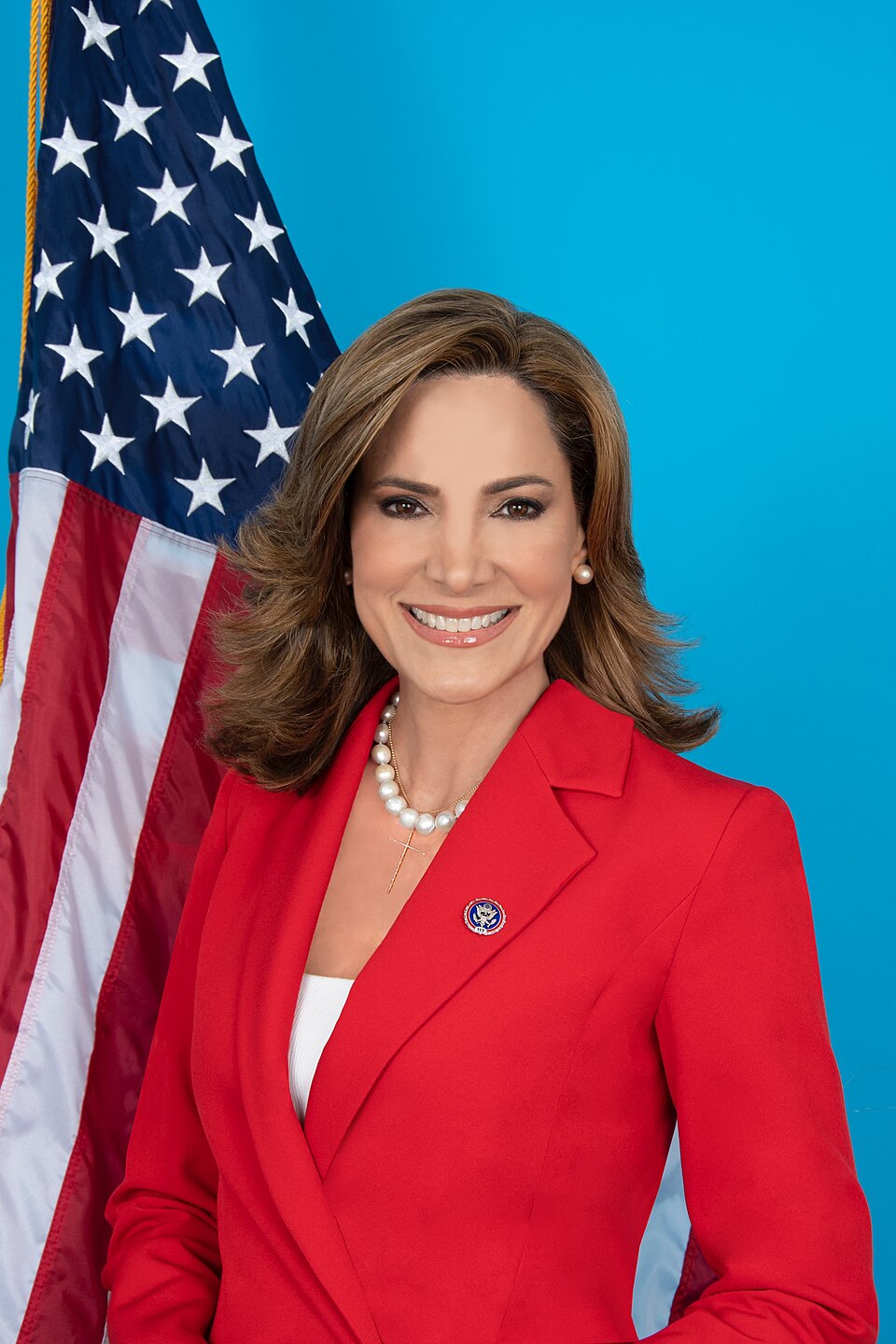
María Elvira Salazar is a Republican U.S. representative for Florida’s 27th Congressional District and a former television journalist. She began serving in the House on January 3, 2021. In November 2026, Associated Press reported that she won reelection.
María Elvira Salazar: quick facts
| Detail | Information |
|---|---|
| Born | November 1, 1961, Miami, Florida |
| Age on November 25, 2026 | 65 |
| Party | Republican |
| Congressional district | Florida’s 27th |
| House service began | January 3, 2021 |
| Earlier profession | Journalist |
Early life and education
Her official House biography describes Salazar as the daughter of Cuban exiles, born in Miami’s Little Havana neighborhood. It records her studies at Deerborne School and Miami Dade College, followed by communications studies at the University of Miami and public administration studies at Harvard’s Kennedy School.
The House’s historical biography dates her University of Miami bachelor’s degree to 1983 and Harvard M.P.A. to 1995.
From television journalism to Congress
Her congressional office lists work for Spanish-language broadcasters including Telemundo, Univision, AmericaTeve, MegaTV and CNN en Español. The office also describes her as a five-time Emmy-winning journalist.
The House historical record documents an unsuccessful congressional campaign in 2018 before her election to the 117th Congress. Her television career and political career are separate parts of that chronology; neither needs unsupported claims about search traffic to explain its significance.
The November 2026 election update
Associated Press reported on November 10, 2026 that Salazar won reelection in Florida’s 27th District. The general election is therefore no longer an upcoming contest in this profile.
Her congressional biography, reviewed in November 2026, lists service on the Foreign Affairs and Financial Services committees and leadership of the Western Hemisphere Subcommittee. Committee assignments should be read in the context of that Congress, rather than assumed to be permanent.
A Miami background and a public-facing career
Salazar’s biography connects two forms of public life: reporting on political leaders and later becoming an elected official herself. Her Miami upbringing and Cuban family background form part of the context, while the educational and employment records establish a chronology that can be checked independently of campaign descriptions.
The House historical record supplies particularly useful fixed dates. Her communications degree preceded a long broadcasting career, while the public administration qualification came later. Those are different courses of study, at different stages, and should not be collapsed into an inaccurate claim that she studied journalism at Harvard.
A background in television also helps explain why many constituents knew her before she appeared on a ballot. Recognition from broadcasting, however, is different from an electoral mandate. The latter comes through a campaign and an election, with a defined district and term of service.
Reporting on leaders before seeking office
Her campaign biography describes assignments involving the White House, the Gulf War and interviews with political leaders. It identifies Fidel Castro and Augusto Pinochet among the people she interviewed. These details describe the public work through which she built a broadcasting profile.
A campaign biography is a participant’s account of that career, so its evaluative language should remain attributed. The distinction is useful for readers: the existence of a particular interview and a campaign’s assessment of how significant it was are different kinds of claim.
Moving into politics also changes the role of the person asking the questions. A journalist can examine the decisions of officeholders; a representative must take positions, vote and answer to voters for her own decisions. Salazar’s career includes both roles, rather than one continuing job under different titles.
The route to the House
The House record identifies an unsuccessful 2018 campaign before her election to the 117th Congress. Her service began in January 2021. That sequence matters when describing her experience: the first campaign and the first day in office occurred in different years.
Election coverage from 2026 belongs later in the same chronology. Associated Press reported her reelection on November 10 after the November general election. The result is a completed event, while a future Congress’s organisation and committee assignments are separate matters.
Readers following a representative over several elections should also distinguish district numbers from geographical boundaries. A district number alone is not a complete description of which address falls within it. Current official district maps and address tools provide the relevant information for constituent services.
The Western Hemisphere committee role
The Foreign Affairs Committee’s page for the 119th Congress lists Salazar as chair of the Western Hemisphere Subcommittee. It describes a regional oversight remit aligned with the State Department’s Bureau of Western Hemisphere Affairs, alongside specified responsibilities involving civilian security, democracy and human rights.
A subcommittee chair helps shape hearings and the examination of subjects within that remit. The role is part of the House’s legislative and oversight work; it is different from running the State Department or personally directing U.S. diplomacy.
The committee’s September 15, 2026 hearing record documents her opening remarks concerning Nicaragua’s Ortega-Murillo government. It provides a specific example of the regional subjects addressed during her chairmanship, rather than a general claim about every aspect of U.S. foreign policy.
The Dignity Act and immigration policy
One of Salazar’s prominent legislative initiatives is the Dignity Act. Congress.gov identifies H.R. 4393 as the DIGNIDAD (Dignity) Act of 2025, introduced by Salazar on July 15, 2025. The title and number identify a particular proposal in a particular Congress.
Representative Veronica Escobar’s announcement describes the bipartisan reintroduction and her collaboration with Salazar. That gives the proposal a documented cross-party partnership, rather than making it solely an initiative of one office.
The introduced bill addresses border security and immigration reform. Its official text on GovInfo records referral to multiple House committees. A referral is one step in the legislative process; it does not mean the proposal has become law or created an immediately available immigration benefit.
For a biographical account, the relevant point is her involvement in proposing and advocating legislation. Readers seeking the legal status of any proposal should use its official action history. A politician’s summary explains the sponsor’s case for a bill, while the text and action record establish what was proposed and what steps are documented.
| Year or period | Milestone | Source context |
|---|---|---|
| 1983 | University of Miami bachelor’s degree | House historical biography |
| 1995 | Harvard public administration degree | House historical biography |
| 2018 | Unsuccessful congressional campaign | House historical biography |
| 2021 | House service began | 117th Congress |
| 2025 | H.R. 4393 introduced | Congress.gov legislative record |
| 2026 | Reelection reported | November Associated Press result |
Policy arguments and campaign reporting
During the 2026 campaign, TIME reported her criticism of aspects of President Donald Trump’s immigration enforcement. The September article placed her comments within an election campaign and described her appeal to the president. That is a dated account of a public position, not a prediction of every later vote.
This is one reason a biography should allow room for policy detail alongside party affiliation. A party label identifies a political association, while an individual’s statements, sponsored bills and votes show the positions taken on particular questions. They should be read together rather than treated as interchangeable evidence.
Constituent services beyond legislation
Her official casework page describes assistance for district residents dealing with federal agencies. Examples include questions involving Social Security, veterans benefits, tax administration and immigration processing. The office explains that it may help obtain information or a timely response, while making clear that it cannot guarantee a favourable outcome.
This is a different part of the job from proposing legislation. A policy debate concerns rules affecting many people; casework concerns a resident trying to understand or resolve an individual administrative problem. The office also distinguishes federal issues from matters belonging to state agencies.
For visitors seeking help, the relevant next step is the official service page and its current instructions. A biography can explain that this work exists, but an individual request belongs with the congressional office responsible for the constituent and the agency involved.
Frequently asked questions
Who is María Elvira Salazar?
She is a Republican U.S. representative from Florida and a former television journalist. Her House service began in January 2021, after a broadcasting career that included Spanish-language networks.
How old is María Elvira Salazar?
She turned sixty-five on November 1, 2026. The House historical biography records her birth in Miami on November 1, 1961.
What did she study?
Her official records list a bachelor’s degree from the University of Miami in 1983 and a Master of Public Administration from Harvard in 1995. Her congressional biography identifies the undergraduate field as communications.
Which district does she represent?
Her congressional office identifies Florida’s 27th District. Constituents should use current official address tools when checking district boundaries or requesting assistance from the appropriate representative.
What is her connection with the Dignity Act?
She introduced H.R. 4393 in July 2025 and worked with Democratic Representative Veronica Escobar on the proposal. Sponsoring a bill is different from the proposal becoming enacted law.
Did she win reelection in 2026?
Yes. Associated Press reported her victory on November 10, 2026. Earlier descriptions of an upcoming general election or an unresolved race are therefore outdated.
Is she still a television journalist?
Journalism is her earlier profession; her current public role in the cited records is congressional service. A biographical discussion can explain both without confusing past broadcasting work with her duties as a representative.

Thomas Andrew is the founder of Odubio.com, a digital platform sharing inspiring biographies, news, and stories about global icons and achievers.