
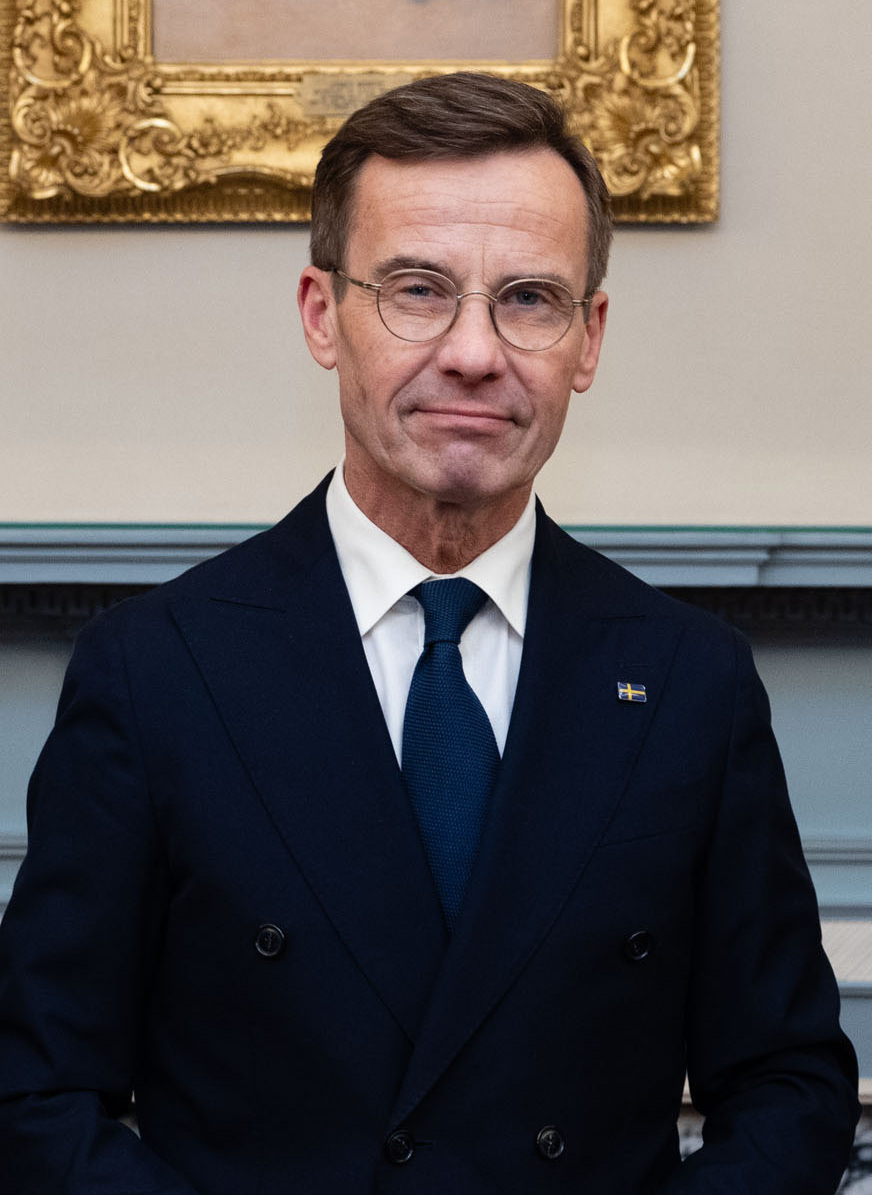
Ulf Kristersson is a Swedish Moderate Party politician who became prime minister in 2022. As of this article’s November 25, 2026 review, the Riksdag describes him as leading a caretaker government while negotiations over a new government continue.
Ulf Kristersson: key facts
| Detail | Information |
|---|---|
| Party | Moderate Party |
| Born | 1963 |
| Education | B.Sc. in Economics, Uppsala University, 1988 |
| Party leadership | Since 2017 |
| Prime ministerial role | Since 2022; caretaker government from September 17, 2026 |
What caretaker prime minister means here
The Riksdag’s government guide records the caretaker administration from September 17, 2026. This is different from saying that a successor has already taken office. Government formation must be distinguished from the election result itself.
Education and political career
His official government résumé records an economics degree from Uppsala in 1988. It lists leadership of the Moderate Youth League, parliamentary service beginning in 1991, municipal roles in Strängnäs and Stockholm, and service as Minister for Social Security from 2010 to 2014. He became Moderate Party leader in 2017.
Sweden’s NATO membership
Sweden joined NATO on March 7, 2024, during Kristersson’s premiership. NATO’s accession announcement records that date. It was not 2023, the year Finland joined.
Latest update: a proposed government faces a vote
On November 24, 2026, Speaker Andreas Norlén announced that he would propose Kristersson as prime minister. The Riksdag’s announcement identifies a proposed government involving the Moderate Party, Centre Party, Christian Democrats and Liberal Party.
The proposal is scheduled for initial tabling on November 26, a second tabling on November 27 and a vote on November 30 at 1 p.m. Swedish time. As of this November 25 review, those steps are still ahead. The announcement establishes a candidate and a parliamentary timetable, not the outcome of the vote.
This supersedes the earlier description that he had only received another week to continue talks. Negotiations had reached the stage of a formal proposal. The caretaker administration remains a separate description of the government in office while the formation process continues.
A career across several levels of government
Kristersson’s official résumé records early leadership of the Moderate Youth League from 1988 to 1992. His first period in the Riksdag ran from 1991 to 2000. He later returned to parliament after roles outside national parliamentary service.
Those intervening positions included municipal finance leadership in Strängnäs and social-affairs responsibilities in Stockholm. He then served as Minister for Social Security from 2010 to 2014, followed by an economic-policy role and the vice-chairmanship of the Finance Committee before becoming party leader.
The sequence shows experience in local administration, a government ministry, parliamentary work and party management. Those are different responsibilities. A municipal office concerns a particular locality, while a ministry and a national party operate within wider political institutions.
How he became prime minister in 2022
The Riksdag’s October 17, 2022 record documents approval of the Speaker’s proposal to appoint Kristersson. The vote was 176 in favour and 173 against, with no abstentions. That is a parliamentary decision, distinct from the general election that preceded it.
The voting record identifies support from the Moderates, Sweden Democrats, Christian Democrats and Liberals. A party’s support in parliament is not automatically the same as holding positions in the cabinet. This distinction is particularly useful when discussing Swedish coalitions and their supporting parties.
It also explains why a prime minister’s biography needs more than an election-year label. The election establishes the composition of parliament; the parliamentary process determines whether a proposed prime minister can take office.
Understanding Sweden’s government-formation process
The Riksdag’s official formation guide explains that the Speaker consults party representatives and prepares a proposal for prime minister. The purpose is to identify a candidate who can form a government with sufficient parliamentary acceptance.
The proposal is rejected if at least 175 members, more than half of the 349-seat chamber, vote against it. Otherwise it is approved. The rule concerns the number opposing a candidate; it is not simply a requirement to collect 175 affirmative votes.
The same guide describes the procedure following a rejected proposal and the limit on the Speaker’s attempts before an extraordinary election becomes necessary. These rules explain why negotiations, abstentions and the willingness to tolerate a government can matter alongside declarations of active support.
For international readers, the practical lesson is to keep three stages separate: an election result, a proposed administration and a government that has actually taken office. Reports can describe different stages accurately while appearing contradictory if their dates and procedural context are omitted.
How the November talks developed
The Riksdag’s November 3 announcement records the Speaker assigning Kristersson the exploratory task after Elisabeth Thand Ringqvist was not approved. Its November 17 update then records a report without a final conclusion and an extension of the talks. The November 24 proposal is the later development in that sequence.
The earlier updates remain useful historical records. They show the process moving through several stages, but they should not be presented as the latest position once a new parliamentary announcement has appeared.
| Date | Recorded development | Meaning at that point |
|---|---|---|
| November 3 | Kristersson receives an exploratory task | Talks begin under the Speaker’s mandate |
| November 17 | Report received; talks extended | No final report yet |
| November 24 | Speaker announces a proposal for prime minister | A parliamentary vote is planned |
| November 26–27 | Scheduled tabling of the proposal | Future steps as of this review |
| November 30 | Scheduled vote | Outcome not yet established on November 25 |
Why NATO membership is a major milestone
NATO’s membership history places Sweden’s application alongside Finland’s in May 2022. Sweden completed accession in March 2024, becoming the alliance’s thirty-second member. The application and accession therefore occurred at different points in the national political chronology.
That distinction also prevents the process being attributed entirely to one person. Kristersson was prime minister when membership was completed, while the application preceded his premiership. Joining an international alliance involved institutions and decisions extending beyond a single announcement.
The Swedish government’s March 7, 2024 statement records the deposit of the accession instrument with the United States government. This was the formal step completing membership. It placed Sweden within NATO’s collective-defence arrangements.
The accession date and the flag ceremony
The flag-raising ceremony at NATO headquarters took place on March 11, four days after accession. It marked the new membership publicly, but did not change the legal date on which Sweden joined.
This is another example of why exact labels matter in a political biography. A ceremony, a parliamentary vote and a formal deposit can all belong to the same development while happening on different days. Keeping them separate gives readers a reliable chronology.
What continues during a caretaker period?
The parliamentary government guide describes a caretaker administration as primarily handling routine or urgent decisions. It also explains that ministers continue visiting the Riksdag for questions, interpellation debates and consultations connected with European Union meetings. Government formation therefore does not mean that every ordinary function of government has stopped.
This is relevant to interpreting appearances by Kristersson during the negotiations. Participation in an official meeting can be consistent with caretaker service. It does not by itself establish that the proposed new administration has already been approved.
Two different NATO milestones
NATO records a flag-raising ceremony on March 11, 2024, several days after formal accession. The ceremony publicly marked the change, while the March 7 deposit of the instrument established the membership date. Accounts using photographs of the ceremony should preserve that difference.
The same care applies to Kristersson personally: attending an international ceremony, leading the government and receiving a fresh parliamentary mandate are different events. A clear biography links them through dates while keeping the responsibility of each institution visible.
These distinctions make the career easier to follow for readers outside Sweden. They explain why a familiar prime minister can remain in office as a caretaker while simultaneously being proposed to lead a newly constituted government.
Frequently asked questions
Who is Ulf Kristersson?
He is a Swedish Moderate Party politician who became prime minister in 2022. In November 2026, he is leading a caretaker administration while a new government-formation process continues.
What is the latest government update?
On November 24, the Speaker announced that he would propose Kristersson as prime minister. The Riksdag vote is scheduled for November 30, 2026; its outcome is not yet known at this article’s November 25 review.
Which party does he lead?
He leads the Moderate Party. His official résumé dates his party leadership to 2017, before his appointment as prime minister.
What did he study?
The government résumé records a Bachelor of Science in Economics from Uppsala University in 1988. It also lists earlier upper-secondary education and national military service.
Does the proposed four-party government already exist?
The November 24 statement describes the parties intended for the proposed government. A proposal should not be reported as an administration that has already completed the parliamentary process and taken office.
When did Sweden join NATO?
Sweden became a member on March 7, 2024. The flag ceremony at NATO headquarters followed on March 11; Finland’s accession had taken place in 2023.
How does the Riksdag approve a prime minister?
It votes on the Speaker’s proposal. Under the rule described by parliament, the proposal fails if at least 175 members vote against it; otherwise it is approved.

Thomas Andrew is the founder of Odubio.com, a digital platform sharing inspiring biographies, news, and stories about global icons and achievers.