
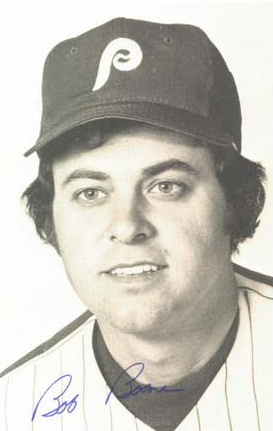
Bob Boone was a major league catcher, seven-time Gold Glove winner and member of Philadelphia’s 1980 championship team. His career also included managing the Royals and Reds. He belonged to a family with three generations of major league players.
Bob Boone’s career at a glance
| Detail | Information |
|---|---|
| Born | November 19, 1947, San Diego |
| College | Stanford |
| Playing teams | Phillies, California Angels and Royals |
| Gold Gloves | Seven |
| All-Star selections | Four |
| World Series title | 1980, Philadelphia |
Stanford and a change of position
Boone played third base at Stanford and also pitched. He led the team in hitting in 1969 with a .311 average and led it in runs batted in during both 1968 and 1969.
Stanford’s Hall of Fame profile records 136 collegiate games, a .297 batting average, 15 home runs and 109 RBIs. Those college numbers cover his work before he became primarily known as a professional catcher.
Philadelphia and the championship
The Phillies selected Boone in the sixth round of the 1969 draft and converted him to catcher in the minors. He reached the majors in 1972.
He hit .412 with four RBIs in the 1980 World Series as Philadelphia won its first title. The National Baseball Hall of Fame’s career feature documents the position change and championship contribution.
Longevity and later managing
Boone finished with 2,225 games caught. Across 19 major league seasons, he recorded 1,838 hits and a .254 batting average. His final Gold Glove came with Kansas City in 1989.
After playing, he managed the Royals during 1995–1997 and the Reds during 2001–2003. His father Ray and sons Bret and Aaron also played in the majors, connecting his career with two other generations.
Death
Boone died on November 9, 2026, aged 78. MLB’s announcement.
A baseball family and a different starting position
Boone’s family connection to the major leagues began with his father, Ray. Bob later became the middle generation between Ray and his own sons, Bret and Aaron. Their shared profession is a notable part of baseball history, but Bob’s own place in it rests on a long career behind the plate.
That career did not begin with catching at Stanford. His college record includes third base and pitching as well as batting. The university’s profile is therefore an important counterpoint to photographs of him in a catcher’s mask: it shows a player whose professional identity developed after his college years.
The transition also changed what his athletic skills were being asked to do. A third baseman reacts to batted balls from the corner of the infield. A catcher receives every pitch, works with the pitcher and controls the ball with runners nearby. Strong hands, an accurate arm and quick reactions matter in both jobs, but the rhythm and preparation differ considerably.
Learning to catch in professional baseball
Philadelphia drafted Boone in 1969 and developed him through the minor leagues. The Hall of Fame’s account describes the conversion to catching within that process, rather than as a position he had always played. It is one of the most consequential changes in his baseball story.
Learning the position required more than changing equipment. A catcher has to receive the pitch cleanly, block balls that bounce, prepare to throw and understand the batter’s situation. The physical movements become useful only when they are coordinated with an awareness of the game.
For Boone, the change led to a major league opportunity in 1972 and a career lasting through 1990. Those endpoints frame 19 seasons of major league play. They also give context to the durability that later became one of the defining features of his reputation.
All-Star recognition and seven Gold Gloves
The career summary records Boone’s four All-Star years as 1976, 1978, 1979 and 1983. His Gold Glove years were 1978, 1979, 1982 and 1986 through 1989. The awards span three organizations and extend into the final part of his playing career.
That distribution is revealing. The first two Gold Gloves came with Philadelphia, four followed with the California Angels, and the final award came with Kansas City. His defensive reputation traveled with him as the surrounding pitching staffs and clubs changed.
Gold Gloves and All-Star selections are different forms of recognition. The former focuses on fielding at a position; the latter identifies selection to a particular season’s showcase. Listing both helps readers see the range of honors without treating them as interchangeable measurements.
The four straight Gold Gloves from 1986 through 1989 are especially striking in a catcher’s career. Catching places repeated demands on the legs, hands and back. Sustaining the position over many seasons requires preparation and recovery as well as the ability to make an individual play.
The 1980 championship in context
Philadelphia’s 1980 World Series title brought Boone’s defensive role together with a strong performance at the plate. His .412 average and four RBIs in the Series belong to that championship matchup, rather than his regular-season batting line.
A short postseason series asks a different question from a full season. A season total describes months of accumulated work; a series can turn on a handful of plate appearances. Boone’s championship contribution is important precisely because it came when Philadelphia was trying to complete the final stage of its season.
Catchers also remain involved when they are not batting. Every opposing plate appearance requires attention to the pitcher, the count and the runners. That continuous involvement is part of why a catcher can be central to a championship team even when the most familiar highlights show someone else hitting or pitching.
Angels seasons and the final Kansas City chapter
Boone moved to the California Angels for the 1982 season and remained there through 1988. His 1983 All-Star selection and four Angels Gold Gloves belong to this chapter. The team name here is the one used during his playing years, preserving the historical setting.
His last two major league seasons, 1989 and 1990, were with Kansas City. The 1989 Gold Glove added another defensive honor after his move. For readers following the team changes, the sequence is Philadelphia, California and Kansas City, followed later by separate managing appointments.
He finished with 2,225 games caught. That number refers to appearances at the position, so it should not be confused with an overall batting statistic or a count of every game his teams played. It provides a direct measure of how extensively he worked behind the plate.
His career batting average was .254, with 1,838 hits. Those totals describe the offensive record across the playing career. Read alongside the catching workload and awards, they help explain a player whose professional value cannot be reduced to one offensive category.
Bob Boone’s playing career by team
| Club | Seasons | Gold Glove years | Other milestone |
|---|---|---|---|
| Philadelphia Phillies | 1972–1981 | 1978, 1979 | 1980 World Series champion |
| California Angels | 1982–1988 | 1982, 1986, 1987, 1988 | 1983 All-Star selection |
| Kansas City Royals | 1989–1990 | 1989 | Final two major league seasons |
From catcher to major league manager
After his playing years, Boone managed the Royals from 1995 into 1997 and the Reds from 2001 into 2003. The managerial register records 371 wins and 444 losses across those appointments, covering 815 games.
Managing placed him in a different relationship with the game. A catcher contributes from within the lineup; a manager must consider the full roster, make substitutions and coordinate a staff. Familiarity with pitchers and game situations can provide useful experience, but it does not make the two jobs identical.
His Reds tenure produced 190 wins and 238 losses. The remaining 181 wins and 206 losses came with Kansas City. Keeping the two clubs separate makes the combined record easier to understand and prevents a playing-season achievement from being mistaken for a managerial result.
The family story continued through Bret and Aaron’s playing careers. It gives supporters several ways to encounter the Boone name, but a clear biography keeps Bob’s championship, awards and managerial record attached to his own work.
Boone’s career rewards a view that includes both continuity and change. The position conversion was a decisive early change; the long catching workload showed continuity; the move into managing opened another role. Those chapters give substance to the familiar description of him as a baseball lifer, while the awards and championship provide clear landmarks for readers discovering his career.
Frequently asked questions
Who was Bob Boone?
He was a major league catcher, seven-time Gold Glove winner and 1980 World Series champion with Philadelphia. He later managed the Kansas City Royals and Cincinnati Reds.
When was Bob Boone born, and when did he die?
He was born November 19, 1947, in San Diego and died November 9, 2026, aged 78, shortly before his 79th birthday.
Did Boone play catcher in college?
His Stanford record centers on third base and includes pitching. Philadelphia converted him to catcher during his minor league development.
How many Gold Gloves did Bob Boone win?
He won seven: two with Philadelphia, four with the California Angels and one with Kansas City. His final award came in 1989.
Did Bob Boone win a World Series?
Yes. He was Philadelphia’s catcher on its 1980 championship team and hit .412 with four RBIs in that World Series.
How are Bob, Ray, Bret and Aaron Boone related?
Ray was Bob’s father. Bret and Aaron are Bob’s sons. Their major league playing careers connect three generations of the Boone family.
What was Bob Boone’s managerial record?
He won 371 games and lost 444 as a major league manager, across the Royals and Reds. Those results are separate from his playing statistics.

Thomas Andrew is the founder of Odubio.com, a digital platform sharing inspiring biographies, news, and stories about global icons and achievers.