
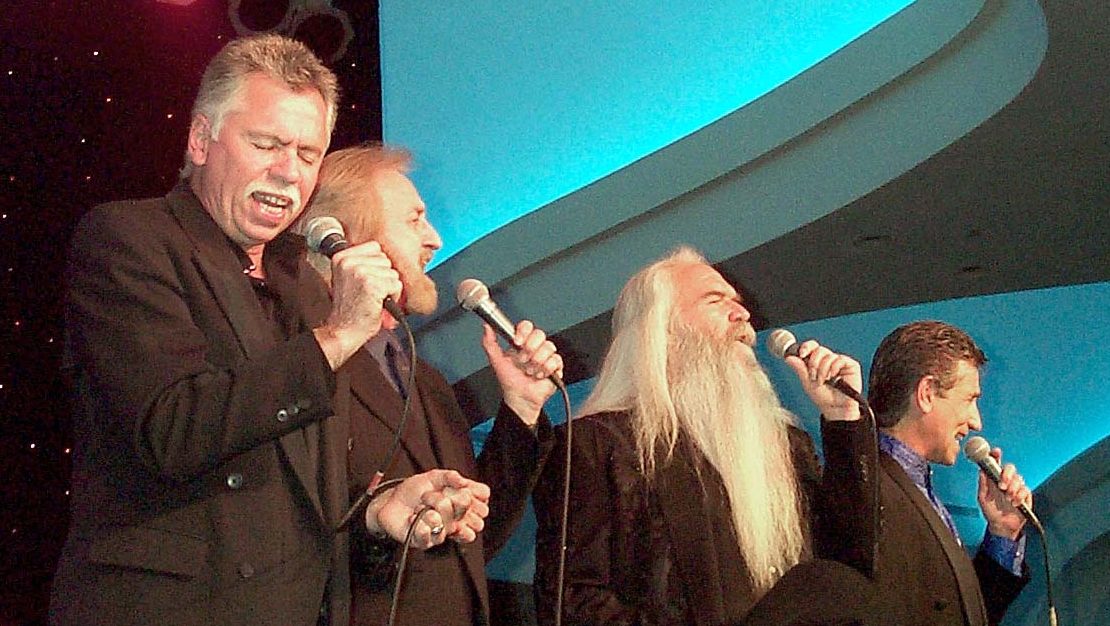
Duane Allen is known as the Oak Ridge Boys’ lead singer and for production work on the group’s recordings. His career connects formal music training with gospel and country quartet singing.
Duane Allen biography: career facts
| Detail | Information |
|---|---|
| Hometown | Taylortown, Texas |
| Joined the Oaks | 1966 |
| Education | Paris Junior College; music degree at Texas A&M University in Commerce |
| Vocal role | Lead singer |
| Other work | Producer, co-producer and executive producer |
Training and quartet singing
The official band biography describes Allen’s training in operatic and quartet singing. His degree studies included voice, piano and composition. He joined the Oaks in 1966, before its major country crossover.
These different settings help explain a career involving both performance and preparation. Formal study, live quartet work and studio production are related experiences, but they are separate credits.
Production work
The band biography identifies Allen as executive producer of The Boys Are Back, co-producer with Ben Isaacs of Rock of Ages, and producer of the live album Boys Night Out. Those distinctions preserve the named contributions of other producers rather than assigning every role to the singer.
A recording’s production credit is useful evidence of professional work. It does not by itself reveal who composed the songs or establish a personal financial return.
Recognition with the Oak Ridge Boys
The Country Music Hall of Fame and Museum lists Allen with Richard Sterban, Joe Bonsall and William Lee Golden as the group’s 2015 inductees. The honor belongs to the documented lineup, while each singer’s earlier career has its own timeline.
Early gospel roots in Texas
Allen’s connection to gospel music began before the Oak Ridge Boys became his professional home. The Texas Gospel Music Hall of Fame recalls his early recording with J. Howard Rogers and the SouthernAires Quartet of Paris, on the Wills family’s Sword & Shield label. It places him within a regional network of singers, music schools and conventions.
That background matters because quartet singing is a shared discipline. A singer must listen to the surrounding parts, match phrasing and make room for another voice when the arrangement changes. Allen’s later country career grew from that kind of group experience, alongside his formal musical education.
In April 1990, Lou Wills Hildreth surprised him with his Texas Gospel Music Hall of Fame induction during a Nashville appearance on Crook & Chase. Her account remembers his appreciation for gospel music and the people involved in his beginnings. It is a particularly personal chapter in a career often summarized through nationally familiar hits.
From the classroom to a national audience
Allen’s education connects his performing life to the Commerce, Texas, university now named East Texas A&M. The Southern Gospel Music Association’s 2025 profile records his B.S. in Music and recognition as a distinguished alumnus of both that university and Paris Junior College. His degree and his honorary doctorate are different distinctions: one followed academic study, while the other was an honor.
His studies in voice, piano and composition offer a useful way to understand his work. Voice training concerns the instrument audiences hear most directly. Piano provides a practical means of exploring harmony, and composition involves decisions about musical structure. Those areas meet when a singer works with arrangements or helps prepare a recording.
The combination does not mean a country performance needs to sound operatic. Different settings call for different choices of delivery. Allen’s career illustrates how a musician can bring a trained ear into an accessible group sound, with attention to the words and the voices around him.
What a lead singer contributes to the quartet
In the familiar Oak Ridge Boys lineup, Allen’s lead voice sat alongside Joe Bonsall’s tenor, William Lee Golden’s baritone and Richard Sterban’s bass. The Grand Ole Opry’s group history dates their arrivals to 1966, 1973, 1965 and 1972 respectively. The quartet existed before those singers came together, so its earliest performances belong to an earlier lineup.
A lead part generally gives listeners a melodic line to follow. Around it, the harmony voices provide depth, movement and contrast. On a well-balanced quartet recording, the listener can follow the story of the song while also enjoying the sound of the ensemble. Each part contributes to that effect.
The title “lead singer” does not mean Allen sang every prominent passage on every track. The group featured different voices, and its most recognizable moments sometimes come from a harmony singer stepping forward. That flexibility is part of the appeal of a vocal group: the arrangement can shift the spotlight without losing the group identity.
The country breakthrough and enduring group identity
The Opry identifies Y’all Come Back Saloon in 1977 as the group’s breakout country recording. “Elvira” later brought the quartet an especially large crossover audience. For Allen, those milestones followed years already spent with the group, rather than marking the beginning of his singing career.
The Country Music Hall of Fame’s history places the quartet within the meeting of gospel harmony and country entertainment. Its 2015 induction recognized the four singers as a group. The honor is distinct from the Opry membership they received on August 6, 2011.
These different recognitions illuminate different relationships. A Hall of Fame induction looks back at a body of work and its place in musical history. Opry membership connects performers with a long-running stage institution. Allen’s biography includes both, alongside honors tied more directly to his Texas roots and gospel background.
Producing the sound as well as performing it
Allen’s production credits add a second dimension to his public career. In a studio setting, the finished vocal is only one element of an album. Song choices, arrangements, musicians, recording decisions and the overall sequence all affect the listening experience. The specific producer credits show where his work extended beyond delivering a lead part.
For example, The Boys Are Back pairs Allen’s executive-producer credit with David Cobb’s producer credit. Boys Night Out documents a different task: presenting country hits as a live album. Preserving those distinctions gives a clearer picture of the projects than applying the same production label to all of them.
Listening to a live collection after a studio album can reveal a different side of an established group. Stage pacing, audience response and the transitions between songs become part of the experience. The repertoire may be familiar, but the recorded setting changes what listeners hear around it.
Community recognition and later gospel honors
In 2014, Lamar County officials honored Allen with a bridge and road near the area where he grew up. The SGMA’s account links that local recognition with his continuing connection to Texas. A community landmark is a different kind of tribute from a music award, placing a performer’s name within the landscape of his beginnings.
The SGMA inducted Allen in 2025. Its profile also describes his long residence in Hendersonville, Tennessee, interest in basketball and enthusiasm for antique cars. These interests add everyday texture to a professional life built around rehearsals, recordings and travel, without needing to turn a biography into an inventory of private possessions.
His work is best approached through several connected strands: the Texas gospel beginnings, the quartet’s country recordings, and the later production credits. Together they show a career sustained through preparation and collaboration as well as a recognizable voice.
A useful listening approach is to follow one song’s melody through a verse and chorus, then return to hear the supporting parts. The lead may feel less conspicuous once the full harmony arrives, yet it still helps orient the listener. That relationship between a clear melodic line and a blended group sound is central to appreciating Allen’s contribution.
Duane Allen’s career at a glance
| Period | Milestone | Why it matters |
|---|---|---|
| Early career | SouthernAires recording experience | Part of his Texas gospel background |
| 1966 | Joined the Oak Ridge Boys | Began his long association with the quartet |
| 1977 | Group country breakthrough | Expanded the audience for its harmony singing |
| 1990 | Texas Gospel Music Hall of Fame | Recognized his gospel contribution |
| 2011 | Opry membership with the group | Added a formal stage affiliation |
| 2015 | Country Music Hall of Fame induction | Recognized the quartet’s legacy |
| 2025 | SGMA Hall of Fame induction | Added individual gospel recognition |
Frequently asked questions
Who is Duane Allen?
He is an American country and gospel singer best known as the Oak Ridge Boys’ lead vocalist. His recording work also includes production and executive-production credits.
When did Allen join the Oak Ridge Boys?
He joined in 1966, during the group’s gospel period and before its major breakthrough on the country charts.
Where is Duane Allen from?
His official biography identifies Taylortown, Texas, as his hometown. His early musical history also connects him with Paris and the surrounding area.
Did Duane Allen study music?
Yes. He attended Paris Junior College and earned a B.S. in Music at the Commerce university now called East Texas A&M, with studies including voice, piano and composition.
What does Allen’s producer credit mean?
It identifies work on the making of a recording beyond his vocal performance. The exact role varies by album, so producer, co-producer and executive producer should retain their separate labels.
Was Allen inducted into the Country Music Hall of Fame?
Yes, as one of the four Oak Ridge Boys members honored in 2015. His separate SGMA Hall of Fame induction followed in 2025.
Which recordings help introduce his career?
The quartet’s country breakthrough Y’all Come Back Saloon, its familiar crossover recordings and the live collection Boys Night Out offer different perspectives on his singing and group work.

Thomas Andrew is the founder of Odubio.com, a digital platform sharing inspiring biographies, news, and stories about global icons and achievers.
[…] For another country act that brought gospel harmony to a wider audience in the same era, read Odubio’s Duane Allen biography. […]