
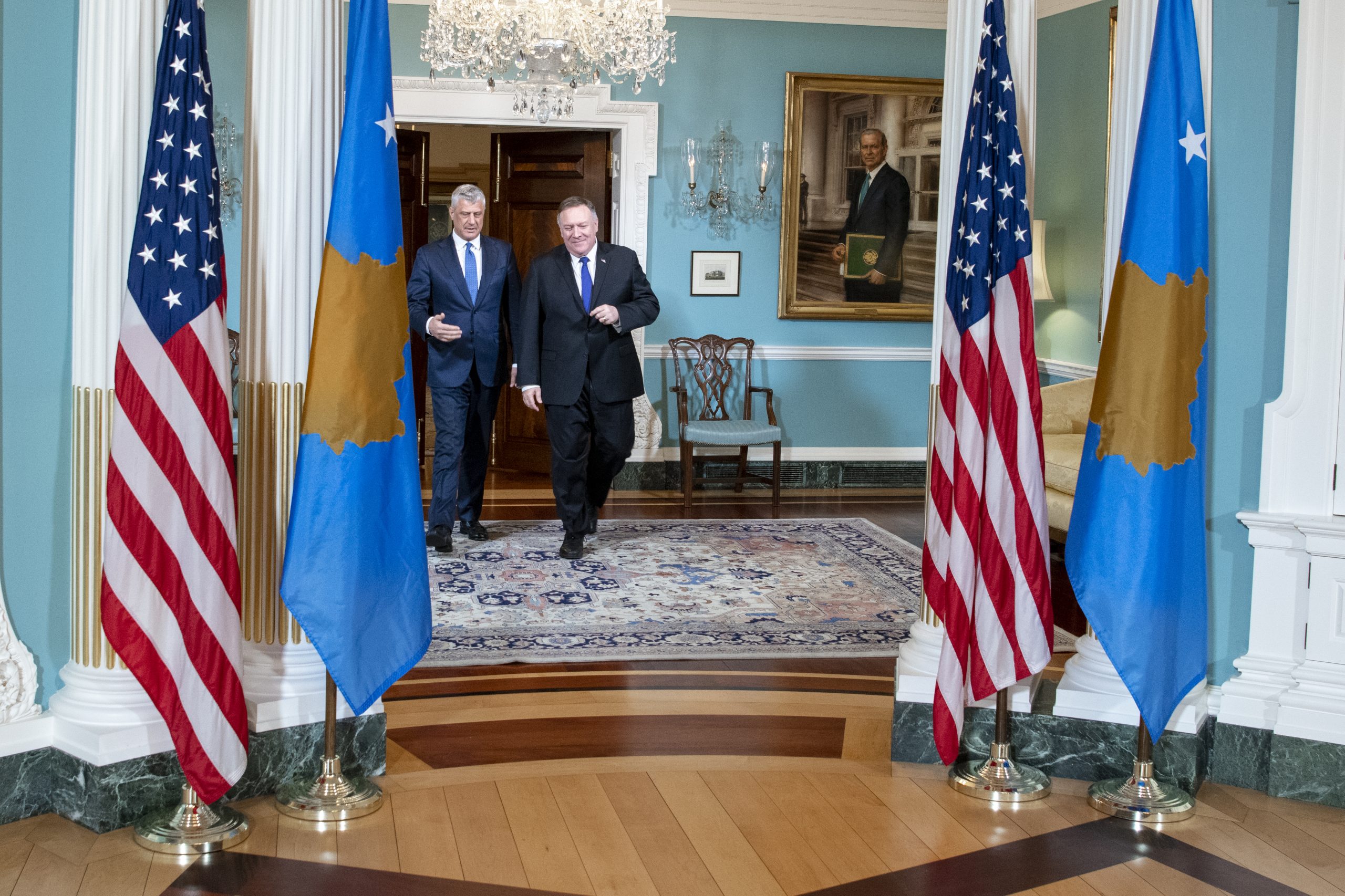
Hashim Thaci, written Hashim Thaçi in Albanian, is a former president and prime minister of Kosovo. He was a political leader of the Kosovo Liberation Army before becoming a central figure in postwar government and Kosovo’s declaration of independence. His later career includes two separate trial judgments at the Kosovo Specialist Chambers in 2026.
As of November 24, 2026, the war-crimes trial has resulted in a 25-year prison sentence, while a separate administration-of-justice case has produced a 17-month sentence. These proceedings concern different conduct and must be described separately. This profile also distinguishes convictions from acquittals and trial decisions from the appeal process.
Hashim Thaci at a glance
| Detail | Information |
|---|---|
| Name | Hashim Thaçi; commonly written Hashim Thaci in English searches |
| Born | April 24, 1968, Burojë, Skenderaj |
| Age | 58 as of November 24, 2026 |
| Studies | History at the University of Pristina; later studies in Zurich |
| Political party | Former leader of the Democratic Party of Kosovo |
| Prime minister | Led the government during the 2008 declaration of independence |
| President | 2016–2020 |
| September 2026 judgment | 25-year sentence in the war-crimes case |
| November 2026 judgment | Separate 17-month administration-of-justice sentence |
Education and early political involvement
Thaçi was born in the village of Burojë in the Skenderaj area. He studied history at the University of Pristina and later pursued studies in Switzerland. His early political activity developed during a period of intense conflict over Kosovo’s status and the position of its Albanian population.
The Kosovo presidency’s archived biography records his educational background and student movement involvement. The archive is useful for his public career, but its references to him as president are historical. He no longer holds that office.
A Foreign Ministry archive also describes his earlier career and studies. Such institutional biographies present an officeholder’s public record from the institution’s perspective; later court findings require separate judicial sources.
Kosovo Liberation Army and Rambouillet
Thaçi became a political leader of the Kosovo Liberation Army, commonly abbreviated KLA. In February 1999, he led the Kosovo delegation at the Rambouillet talks in France. The negotiations placed him before an international audience during the conflict.
After the war, he moved into the structures of postwar administration and party politics. The shift from an armed movement to public institutions is an essential part of his biography. His later criminal proceedings concern individual responsibility for particular conduct; they are not interchangeable with a general history of Kosovo’s independence movement.
The distinction also matters for victims. A political explanation of the conflict does not replace examination of specific abuses, and a court judgment about named defendants does not determine the responsibility of every person associated with a movement.
Party leadership and the premiership
Thaçi led the Democratic Party of Kosovo after the conflict. Following the party’s 2007 election victory, he became prime minister in January 2008. The Foreign Ministry archive records January 9 as the date of his election to lead the government.
On February 17, 2008, Kosovo declared independence while he was prime minister. That moment established his place in the country’s political history. His government responsibilities subsequently extended beyond the declaration into the work of building institutions and conducting international relations.
His political prominence also made later developments closely watched at home and abroad. For many supporters, his name remained connected with independence; the court proceedings required attention to allegations and evidence distinct from that political standing.
The 2013 dialogue with Serbia
As prime minister, Thaçi participated in European Union-facilitated dialogue with Serbia. On April 19, 2013, he and Serbian Prime Minister Ivica Dačić reached an agreement on normalization.
The European Council president’s statement welcomed the agreement and emphasized implementation. It also linked progress in the dialogue with the parties’ relationships with the European Union.
The agreement was an important diplomatic development, but it should not be described as resolving every issue between Serbia and Kosovo. Reaching a negotiated text and carrying out its provisions are separate tasks. The European Council’s own statement stressed that concrete implementation was necessary.
President from 2016 to 2020
Kosovo’s Assembly elected Thaçi president on February 26, 2016, and he took office on April 7. The presidency followed his earlier government and party leadership roles.
He resigned on November 5, 2020, after learning that an indictment against him had been confirmed. Reuters’ report from that day documents his departure and his decision to face the proceedings in The Hague.
At that stage, an indictment was a formal accusation, not a conviction. The later trial judgments changed the legal position, which is why a current biography cannot stop at the language used when he resigned.
What the Kosovo Specialist Chambers are
The court’s institutional background page explains that Kosovo’s Assembly adopted the constitutional amendment and law establishing the Specialist Chambers and Specialist Prosecutor’s Office in 2015. The institutions are staffed internationally and have a seat in The Hague.
They should not be confused with every other international court based in that city. Identifying the institution correctly helps readers follow its case numbers, rules and judgments. The Specialist Prosecutor’s Office brings cases, while judges decide the matters placed before them.
The distinction between prosecution and court is fundamental. A prosecutor’s allegation or sentencing request is not itself the judgment. This article uses the court’s announcements for findings and sentences rather than treating earlier accusations as the final outcome.
The September 2026 war-crimes judgment
On September 16, 2026, the Trial Panel pronounced judgment in case KSC-BC-2020-06, concerning Thaçi, Kadri Veseli, Rexhep Selimi and Jakup Krasniqi. The official case chronology records the trial stages and the result.
The panel convicted the defendants of war crimes involving illegal or arbitrary detention, cruel treatment, torture and murder. Thaçi received a 25-year sentence. The court’s judgment announcement also records acquittals on crimes against humanity and on some specific war-crime incidents.
Including those acquittals is necessary for an accurate account. The result was not a conviction on every allegation. The panel explained that the prosecution had not proved the required widespread or systematic attack for the crimes-against-humanity charges beyond reasonable doubt.
The court emphasized that the trial concerned the criminal conduct and responsibility of the accused. It was not deciding the legitimacy of Kosovo’s independence goal or adjudicating every crime committed during the conflict. The public judgment summary provides the fuller account of its reasoning.
The separate November 2026 judgment
On November 17, 2026, a Single Trial Judge delivered judgment in a different case involving offences against the administration of justice. The court’s announcement describes findings concerning confidential witness information and instructions communicated through detention visitors.
Thaçi was found guilty of attempted obstruction of official persons, violating the secrecy of proceedings and contempt of court. The judge imposed 17 months’ imprisonment, to be served separately from the sentence in the war-crimes case.
The judgment also included acquittals on particular allegations. It should therefore be read according to its individual findings rather than summarized as proof that every alleged communication occurred. The proceedings concerned conduct linked to the integrity of another trial, not a second trial of the same wartime offences.
Appeal process and current legal status
The court’s November 5 briefing states that the deadline for notices of appeal in the war-crimes case was extended to November 27. It explains that an appeals panel may affirm, reverse or revise a trial judgment after reviewing grounds raised by the parties.
As of November 24, this profile records trial judgments and does not claim that an appeal judgment has upheld or overturned them. A procedural deadline is not an appeal outcome. Future updates should identify the actual filing or decision and the case to which it belongs.
Political and legal timeline
| Date | Event | Meaning |
|---|---|---|
| February 1999 | Led delegation at Rambouillet | International negotiations during the conflict |
| January 2008 | Became prime minister | Government leadership after the 2007 election |
| February 17, 2008 | Declaration of independence | Central milestone of his premiership |
| April 2013 | Normalization agreement with Serbia | EU-facilitated dialogue |
| April 2016 | Entered presidency | Head-of-state office |
| November 2020 | Resigned | Left office after indictment confirmation |
| September 16, 2026 | War-crimes trial judgment | 25-year sentence; acquittals also recorded |
| November 17, 2026 | Administration-of-justice judgment | Separate 17-month sentence |
Frequently asked questions
Who is Hashim Thaci?
He is a former Kosovo president and prime minister and a former political leader of the Kosovo Liberation Army.
How old is Hashim Thaci?
He is 58 as of November 24, 2026. He was born on April 24, 1968.
Are Thaci and Thaçi the same name?
Yes. Thaçi is the Albanian spelling, while Thaci commonly appears in English-language reporting and searches.
When was he president?
He entered office in April 2016 and resigned in November 2020.
What was the September 2026 sentence?
The Trial Panel imposed 25 years for war crimes. It also acquitted the defendants of crimes against humanity and some specific incidents.
Was the November judgment the same case?
No. It concerned administration-of-justice offences and resulted in a separate 17-month sentence for Thaçi.
Are these appeal judgments?
No. The decisions described here are trial judgments. The war-crimes appeal-notice deadline was extended to November 27, 2026.

Thomas Andrew is the founder of Odubio.com, a digital platform sharing inspiring biographies, news, and stories about global icons and achievers.