
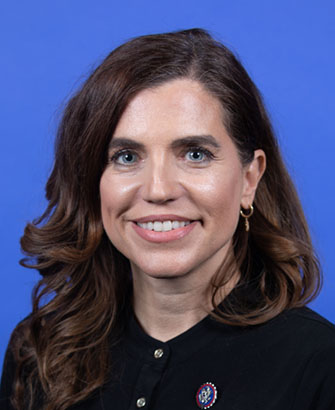
Nancy Mace’s exact net worth is not established by the estimates linked below. Quiver Quantitative put it at approximately $353,000 on August 20, 2026, while Celebrity Net Worth published a much higher $3 million estimate. Those are publishers’ calculations, not interchangeable statements of her total personal wealth.
Nancy Mace net worth: comparing the figures
| Source | Published figure | How to read it |
|---|---|---|
| Quiver Quantitative, August 20, 2026 | $353,000 | Estimate produced from disclosure-tracking software |
| Celebrity Net Worth | $3 million | Publisher’s estimate, not an official wealth declaration |
| House financial disclosures | Reportable assets and liabilities | Reporting rules and valuation categories limit what can be calculated |
Why the estimates differ
Quiver’s dated report says its software parsed a new annual financial disclosure. The date matters: a tracker estimate is a snapshot, rather than a guaranteed current balance.
Celebrity Net Worth’s profile gives $3 million. It should be attributed to that publication rather than presented as an official finding. Averaging the two numbers would not produce a more reliable answer, because the estimates may reflect different assumptions and coverage.
What congressional disclosures can show
The House Ethics Committee explains the financial-disclosure framework. Reports identify financial interests under specific rules; they are not personal balance sheets covering every possession.
For example, the House’s financial-disclosure instructions exclude a personal residence from the asset schedule unless it generated rental income during the reporting period. Reporting exclusions and value bands can make a simple assets-minus-debts calculation incomplete.
Her professional background
The Congressional Directory records Mace’s business-administration degree from The Citadel in 1999 and master’s degree from the University of Georgia in 2004. It also lists her public-relations business and earlier South Carolina legislative service.
The short answer to the wealth question
The available sources support a comparison of published estimates, rather than a declaration of one exact fortune. The gap between $353,000 and $3 million is substantial. It is a reason to examine what the publishers measured, not a reason to select whichever number makes the more striking headline.
Both figures should keep their source labels and dates. A reader can then distinguish a disclosure-based tracker snapshot from a broader celebrity-finance estimate. Neither becomes an official personal balance sheet merely because it appears prominently in search results.
That is also why this article does not convert the difference into a claim about hidden money, unexplained losses or wrongdoing. Different coverage and calculation methods can produce different estimates. Establishing misconduct would require separate evidence, not just two conflicting numbers.
What Quiver actually reported
Quiver’s August 20 article says that its software parsed a new annual disclosure. It lists examples of holdings using upper limits, including checking, retirement and college-savings accounts. An amount described as “up to” a particular figure is not an exact account balance.
The reported $353,000 is the tracker’s estimate based on its process. It should not be presented as a statement that Mace personally confirmed that total on the publication date. The page identifies the calculation as the publisher’s own estimate.
Even where a financial record is genuine, interpretation matters. A form can accurately describe reportable interests under its rules while still lacking the information needed for an exact personal wealth calculation. A tracker adds another layer of assumptions when it converts categories into a single number.
Why ranges create uncertainty
Consider a purely illustrative asset reported within a range. Two people can each report the same category while holding different amounts within it. If liabilities are also given as ranges, subtracting their midpoints produces an estimate based on chosen assumptions, not an exact result supplied by the filer.
This example is about how to read categories; it is not a claim about any undisclosed asset owned by Mace. Its purpose is to show why a precise-looking output can rest on less precise inputs.
The residence exclusion described in the House instructions adds another limitation. A disclosure system designed to reveal relevant financial interests is not necessarily designed to value every item in a household. Its transparency purpose should be distinguished from a commercial wealth ranking.
A career before congressional salary
The Congressional Directory describes Mace as founder and president of The Mace Group, a public-relations, marketing and web-services consulting business. It also records her authorship and her South Carolina House service before entering Congress.
These are documented professional activities. They explain why an account of her finances may refer to business and publishing as well as elected office. They do not establish the revenue of the business, her personal profit from it or the value of any remaining ownership interest.
Business revenue, compensation and net worth answer different questions. Revenue concerns what a business receives; compensation concerns payment to a person; net worth concerns assets less liabilities at a point in time. Treating all three as the same figure would make the financial story less accurate.
The Citadel milestone
The Citadel’s history of women at the institution identifies Mace as the first woman to graduate from its Corps of Cadets in 1999. The wording matters: it is a specific milestone in the cadet programme’s history, rather than a claim that no woman had previously studied at the institution in any setting.
The university places that event within a longer sequence involving women’s admission and later leadership roles. Her graduation is therefore both an individual achievement and part of an institutional change that continued after she left.
The same history records her return as the 2024 Corps of Cadets commencement speaker. That later appearance linked her public career with the educational milestone for which she had first become nationally known.
Her memoir and further study
The Citadel library’s women’s-history guide lists In the Company of Men: A Woman at The Citadel, identifying Nancy Mace and Mary Jane Ross. The book is a source for her personal account of that experience, while institutional records establish the graduation milestone.
South Carolina’s legislative biography also records the book, a 2004 University of Georgia postgraduate degree and earlier alumni and advisory-board activity. These details broaden the professional chronology beyond a single election or a wealth estimate.
The existence of a published book does not disclose the author’s total royalties. Without a contract or financial record establishing those terms, sales assumptions should not be inserted into a net-worth calculation.
| Milestone | Record | Financial limit |
|---|---|---|
| 1999 Citadel graduation | First female Corps of Cadets graduate | An educational achievement, not a wealth figure |
| 2001 memoir | In the Company of Men | Publication does not disclose total royalties |
| Consulting business | The Mace Group listed in the Congressional Directory | No verified personal profit established here |
| 2018–2020 state service | South Carolina House of Representatives | A career period, not a complete earnings statement |
| 2020 congressional election | Elected to the 117th Congress | Officeholding does not establish personal net worth |
The 2026 political update
Associated Press reported in June 2026 that Mace finished fifth in the Republican primary for South Carolina governor. The completed primary result should replace any description that still presents her as awaiting that contest.
The political result does not itself establish a change in her personal wealth. Campaign finances, office expenses and personal assets are separate records. A donation to a campaign should not be casually added to an estimate of the candidate’s private fortune.
What would make an estimate more useful?
A useful estimate explains its date, the documents it uses and how it handles ranges and exclusions. It should also make clear whether it is estimating a person’s total wealth or only the interests visible in a particular disclosure system.
For Mace, the strongest conclusion remains limited but clear: two named publications offer different figures, and the official disclosure framework does not make either figure a complete, exact total. Readers can follow the linked records while keeping that uncertainty visible.
Frequently asked questions
What is Nancy Mace’s net worth?
No exact current total is established here. Quiver estimated $353,000 in August 2026, while Celebrity Net Worth published $3 million. Both require attribution rather than presentation as an official balance sheet.
Why do the estimates differ?
Publishers may use different documents, dates, coverage and assumptions. Disclosure ranges and reporting exclusions make a precise personal calculation difficult, even when the underlying records are public.
Should the two figures be averaged?
No. Averaging estimates with different methods does not resolve the differences between them. It would create a new number without an independently established basis.
What business did she run?
The Congressional Directory lists The Mace Group, a public-relations, marketing and web-services consulting business. It does not provide the complete personal profit or current valuation needed for a wealth calculation.
Was she the first woman to graduate from The Citadel?
She was the first female graduate of its Corps of Cadets in 1999. That is the precise milestone documented by the institution’s history.
Did she win the 2026 governor primary?
No. The June Associated Press report records a fifth-place finish in the Republican primary. This was a completed campaign result, separate from the financial estimates discussed above.
Do campaign donations count as personal wealth?
They should not be treated as personal assets merely because they support a candidate. Campaign records and personal financial disclosures serve different purposes and should be read separately.

Thomas Andrew is the founder of Odubio.com, a digital platform sharing inspiring biographies, news, and stories about global icons and achievers.