
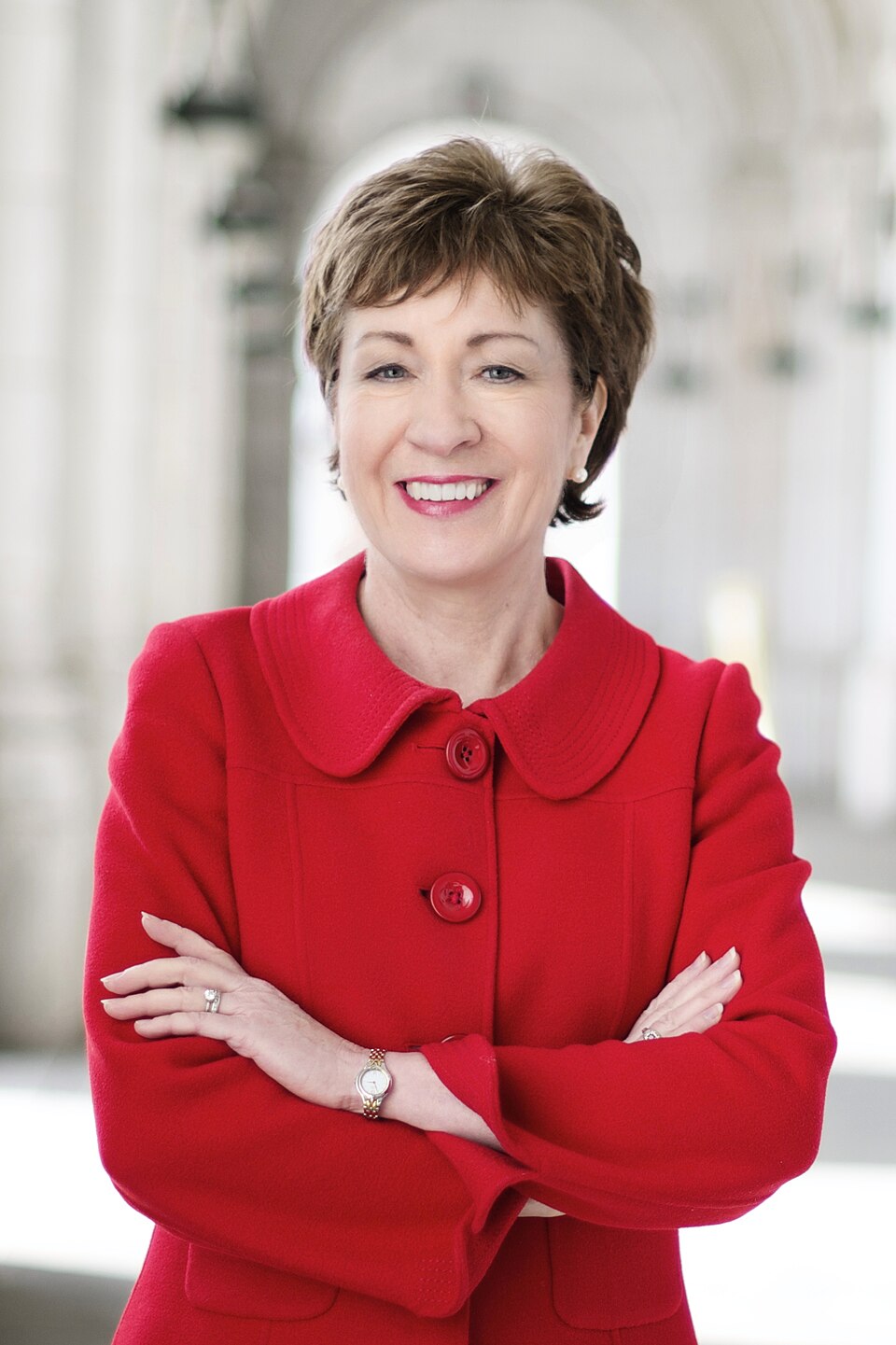
Susan Collins is 73 years old in November 2026 and turns 74 on December 7. She was born on December 7, 1952, in Caribou, Maine. The Republican senator first won election in 1996 and began serving in January 1997, building a career that includes committee leadership, bipartisan legislation and several closely watched national votes.
Her latest election result is a separate part of the timeline. Collins conceded the November 2026 Senate race to Democrat Troy Jackson, but she remains a serving senator until her term ends in January 2027. Her birthday, current office and electoral defeat should therefore be described with their own dates.
Susan Collins age and career at a glance
| Detail | Verified information |
|---|---|
| Full name | Susan Margaret Collins |
| Born | December 7, 1952, Caribou, Maine |
| Age | 73 in November 2026; turns 74 on December 7 |
| University | St. Lawrence University, class of 1975 |
| Party | Republican |
| First Senate election | 1996, for service beginning in 1997 |
| 2026 committee role | Chair of the Senate Appropriations Committee |
| Final term ending | January 3, 2027, after her 2026 election defeat |
How old is Susan Collins?
Collins was born in 1952, but subtracting that year from 2026 does not by itself establish her completed-years age before her birthday. She remains 73 until December 7, 2026, when she turns 74. The official congressional biography records the birth date used for that calculation.
This is why an article written early in December can legitimately give a different age from one written later in the month. The number should be checked against the date rather than copied indefinitely from an older headline. Her age also provides no independent basis for making a medical assessment.
Collins’s long Senate tenure is another measure of time, but it answers a different question. She entered the chamber in 1997, decades after her birth and after a substantial period working in government. Her biography includes that preparation as well as the years she spent in elected federal office.
Caribou roots and university education
Collins grew up in Caribou in northern Maine. Her official Senate biography describes a family lumber business whose history reaches back to the nineteenth century. That background connects her to the state she later represented, rather than presenting her career as beginning only with national television coverage.
She graduated Phi Beta Kappa from St. Lawrence University in 1975. Her education preceded work for Maine politician William Cohen, then a member of the House of Representatives and later a senator. The progression gave her experience with congressional work before she became a candidate herself.
St. Lawrence and her later public offices should not be confused with an honorary degree or a professional title. The academic qualification, staff employment and elected Senate service are distinct stages in the same career.
Working for William Cohen and in state government
The congressional biography records Collins’s work for Cohen from 1975 through 1987. Her responsibilities included directing the staff of a Senate governmental-oversight subcommittee. That placed her in work involving how public institutions operate and how Congress examines their performance.
She subsequently led Maine’s Department of Professional and Financial Regulation from 1987 to 1992. Other government work included a New England regional position with the Small Business Administration and service as a deputy state treasurer in Massachusetts. These were administrative positions, separate from her later authority as a senator.
The different offices help explain the subjects that became part of her Senate record: oversight, public spending, small businesses and the practical operation of government. They also show that her career involved more than campaigns, even though elections ultimately determined her time in the Senate.
The 1994 governor’s race and 1996 Senate election
Collins won an eight-way Republican primary for governor of Maine in 1994, becoming the first woman nominated for that office by a major party in the state. She lost the general election. That unsuccessful statewide race preceded her successful campaign for the Senate two years later.
She won the 1996 Senate election to succeed Cohen and began serving in January 1997. Reelection victories followed in 2002, 2008, 2014 and 2020. In 2020, she became the first Republican woman elected to a fifth Senate term, as her official biography records.
These dates distinguish being elected from taking office. The 1996 result began a term in the following January; similarly, the 2026 result determines who serves in the next term rather than immediately removing the incumbent on election night.
Committee leadership and intelligence reform
Collins chaired the Governmental Affairs Committee and later the renamed Homeland Security and Governmental Affairs Committee. Her work with Senator Joseph Lieberman became associated with a major intelligence-reform effort after the September 11 attacks.
A December 2004 committee announcement records Senate passage of the Collins-Lieberman Intelligence Reform and Terrorism Prevention Act by 89 votes to two. The legislation was sent to President George W. Bush. The record supplies a specific example of bipartisan legislative work, rather than relying only on a general reputation for moderation.
Her later statement about the law highlighted the Privacy and Civil Liberties Oversight Board. That example shows the legislation’s relationship to oversight as well as national security. It also connects the topic with experience she had acquired while working on governmental management as a staff member.
Appropriations and the meaning of seniority
During the 119th Congress, Collins served as chair of the Senate Appropriations Committee. Appropriations work concerns federal spending legislation. The committee role is therefore different from leading the entire Senate or directing a federal department.
Seniority can create opportunities to influence the agenda, negotiate funding and advocate for projects in a senator’s state. It does not give one member personal ownership of the money Congress allocates. Public project totals and legislative funding should never be described as a senator’s private income.
Associated Press’s October 2026 reporting examined how Collins used local events to highlight federally supported projects during her reelection campaign. That gives a concrete example of the connection between committee work, constituent interests and electoral politics, while leaving voters free to assess the record differently.
Votes that drew national attention
Collins’s reputation for crossing party lines does not mean she opposed her party on every major issue. Her decisions need to be assessed individually. The Senate press gallery’s October 2018 record, for example, documents her speech supporting Brett Kavanaugh’s Supreme Court nomination.
In February 2021, she voted to find Donald Trump guilty in his second impeachment trial. The Congressional Record preserves the roll call. The Senate’s overall 57–43 vote fell short of the two-thirds required for conviction, so Trump was acquitted.
Those examples illustrate why a political label cannot replace the voting record. Supporters may emphasize instances of independence, while critics may focus on consequential votes supporting Republican priorities. The underlying vote, the question before the Senate and the final institutional outcome are more informative than assuming a label predicts every decision.
The 10,000-vote milestone and health-policy work
On June 4, 2026, Collins cast her ten-thousandth consecutive Senate roll-call vote. Her office’s announcement dates the milestone and describes a streak beginning in 1997. It is a record of attendance in roll-call voting, not a claim that every senator agreed with the positions she took.
Her later legislative work also included diabetes research. A November 2026 statement from Senator Jeanne Shaheen’s office documents their joint effort with other lawmakers to extend the Special Diabetes Program. It distinguishes funding already secured at a higher annual rate from the request for another reauthorization.
That difference matters when describing legislative accomplishments. A letter urging Congress to act is a documented advocacy step, but it does not establish that the requested extension has already become law. Pending work should retain its status and date.
| Date or period | Milestone | Context |
|---|---|---|
| 1975 | Graduated from St. Lawrence | Then began congressional staff work |
| 1994 | Republican nominee for Maine governor | Lost the general election |
| 1996–1997 | Won Senate election and took office | Election and inauguration occurred in different years |
| 2004 | Intelligence-reform legislation passed | Work with Senator Joseph Lieberman |
| June 2026 | 10,000 consecutive roll-call votes | A dated attendance milestone |
| November 2026 | Conceded Senate race to Troy Jackson | Her existing term continued afterward |
The November 2026 election result
ABC News reported early on November 4 that Collins had called Troy Jackson to congratulate him and conceded her reelection race. The result ended her bid for a sixth term. It did not change the date of her upcoming birthday or terminate the current term immediately.
Her congressional biography gives January 3, 2027, as the end of the term won in 2020. During the final weeks of 2026, an accurate profile therefore describes her as a serving senator after electoral defeat, rather than as someone already replaced in office.
Frequently asked questions
How old is Susan Collins?
She is 73 in November 2026 and turns 74 on December 7, 2026.
Where was Susan Collins born?
She was born in Caribou, Maine, on December 7, 1952.
Where did she attend university?
She graduated from St. Lawrence University in 1975.
When did she first win her Senate seat?
She won in 1996 and began serving in January 1997.
Did she win the 2026 election?
No. She conceded the race to Democratic challenger Troy Jackson in November 2026.
Does that mean she left office on election night?
No. The existing term continues until January 3, 2027.
What was her June 2026 voting milestone?
She cast her ten-thousandth consecutive Senate roll-call vote, extending a streak that began with her Senate service.

Thomas Andrew is the founder of Odubio.com, a digital platform sharing inspiring biographies, news, and stories about global icons and achievers.