
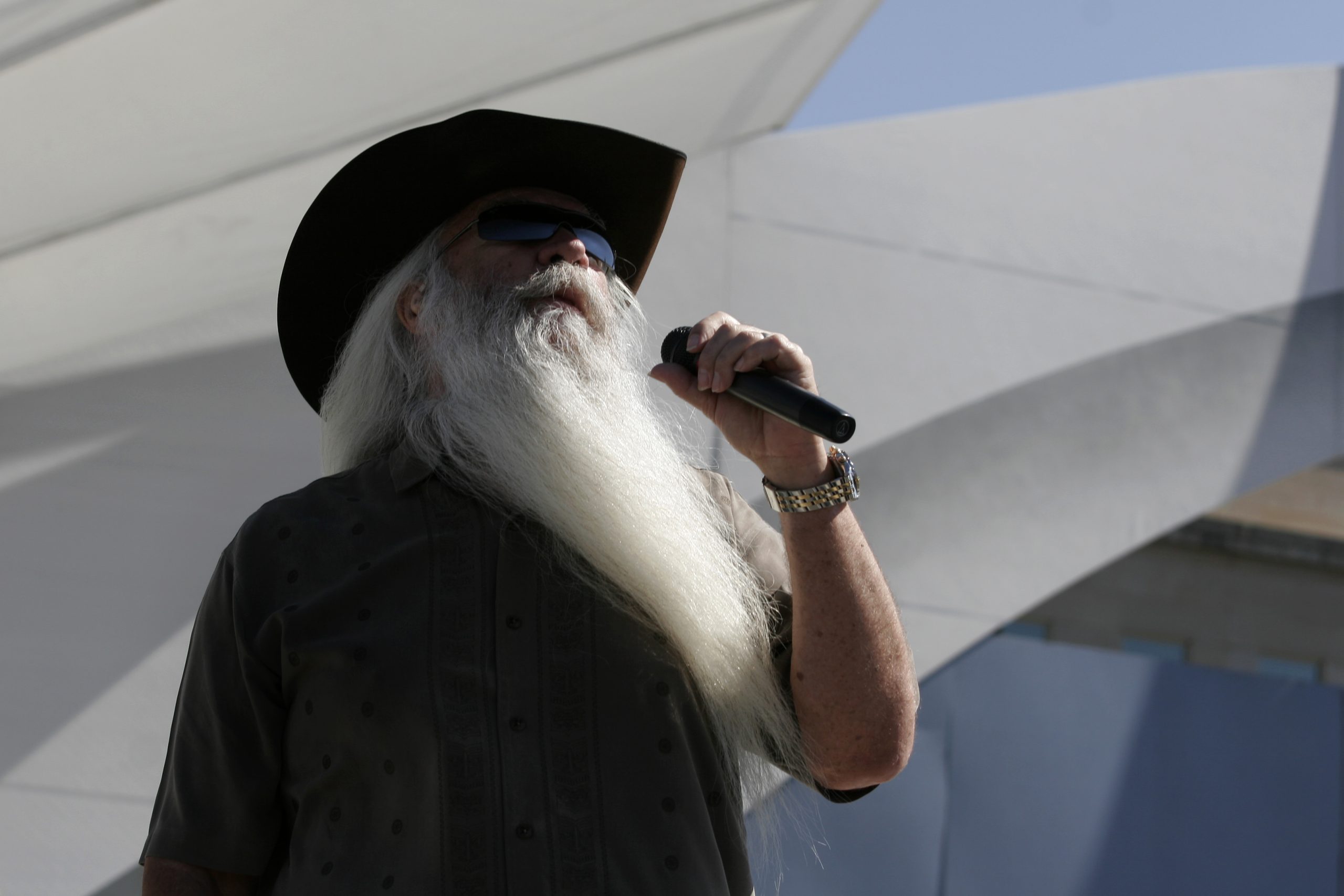
William Lee Golden is a baritone singer associated with the Oak Ridge Boys and with solo and family recording projects. His biography includes a long quartet career, a period outside the group and a return to its familiar lineup.
William Lee Golden: key facts
| Detail | Information |
|---|---|
| Born | January 12, 1939 |
| Hometown | Brewton, Alabama |
| Vocal part | Baritone |
| Oak Ridge Boys timeline | Joined 1965; left 1987; returned 1996 |
| Solo album | American Vagabond (1986) |
| Autobiography | Behind the Beard |
Alabama beginnings and the Oak Ridge Boys
The Alabama Music Hall of Fame biography records Golden singing and playing guitar on hometown radio at seven. He joined the Oak Ridge Boys in 1965, during its gospel period, and participated in its later move into country music.
The institution identifies his baritone on recordings including “Thank God for Kids.” It also records his 1997 induction and performing-achievement recognition. These are documented milestones rather than descriptions of a current touring schedule.
Solo work and return
The same Hall of Fame record dates American Vagabond to 1986 and his departure from the quartet to 1987. He performed independently and with his sons before rejoining the Oaks in 1996.
Those periods help explain why his discography includes work under more than one artist name. A solo record, a quartet recording and a family-band project should retain their separate credits.
The Goldens and Behind the Beard
The family group’s official history describes a multigenerational project and a three-album collection covering vintage country, pop and country rock, and gospel. It also records the Goldens’ Grand Ole Opry debut in June 2022.
Golden’s book site identifies Behind the Beard as his autobiography. A memoir supplies the author’s personal account; it should be distinguished from an institution’s award or discography record.
The voice behind the familiar image
Golden’s long hair and flowing beard make him easy to recognize, but his place in the Oak Ridge Boys begins with the music. A quartet needs four singers whose voices remain distinguishable while fitting together. The baritone occupies the space between the lead and bass, giving the harmony body without competing with the melody. Listening for that middle voice reveals a contribution that a photograph cannot convey.
In the celebrated lineup, Duane Allen supplied lead vocals, Joe Bonsall sang tenor and Richard Sterban provided the bass. Golden’s baritone completed that combination. The arrangement allowed the group to move from an intimate verse to a broad chorus while preserving its identity. Each singer could step forward, then return to the blend. That balance is central to understanding Golden’s career: his individuality worked inside a shared sound.
A gospel quartet becomes a country institution
The Grand Ole Opry’s artist history traces the group to the World War II period, well before Golden joined. Its early recordings and Opry appearances belonged to an earlier generation of performers. Golden’s arrival in 1965 therefore began his own chapter in an established musical tradition rather than the founding of a new band.
Allen joined in 1966, Sterban in 1972 and Bonsall in 1973. Their sequence of arrivals matters because the famous lineup developed gradually. The group’s 1977 country breakthrough, “Y’all Come Back Saloon,” came after years of gospel work. Country success expanded the audience for its harmony singing; it did not erase the musical discipline that had shaped the act.
For a listener, the transition can be heard as a change of setting. A quartet’s coordinated entrances, sustained chords and contrasting registers can serve a gospel message or a country story. Golden’s career connects those settings. His long association with both styles helps explain why a family gospel project later in his life fits naturally beside the country recordings.
Featured performances and a solo identity
“Thank God for Kids” is an especially useful introduction to Golden because it places his voice in the foreground. Its affectionate perspective gives the singer room to communicate directly rather than rely on vocal spectacle. It also offers a different entry point from the group’s larger, more exuberant crossover hits.
His solo album American Vagabond presents another route into the catalog. A solo billing changes the listener’s focus: instead of following four named personalities across a performance, the audience follows one artist through a complete collection. Golden’s independent recordings belong alongside the quartet work when considering the range of his career.
The Alabama Music Hall of Fame also documents his “Louisiana Red Dirt Highway” video and its strong CMT showing in 1991. That activity falls between his departure and return to the Oak Ridge Boys. It makes the intervening years part of an active performing career, rather than an empty space between two group memberships.
Books, photographs and life beyond the microphone
Behind the Beard gives Golden space to tell his own story. The official book site describes a memoir covering childhood, adolescence, personal life and the journey from Alabama into professional music. Its title draws on his best-known visual feature, but the project reaches further into the experiences behind that public image.
The hardcover includes more than 200 photographs from his personal collection. Those pictures add a visual dimension to the written recollections: readers can follow changes in surroundings, appearance and professional life alongside the narrative. As with any autobiography, its particular value is access to the subject’s perspective.
A different book, Golden Memories, collects landscape photographs he took while traveling with the Oak Ridge Boys. Its focus shifts from the performer to what he saw on the road. The distinction is appealing: one volume tells a life story, while the other invites readers to look through the artist’s camera.
The Oak Ridge Boys’ personal biography also identifies painting among Golden’s interests. Together, singing, painting and photography suggest several ways of observing and communicating. A concert unfolds in time; a landscape photograph asks someone to pause over a single view. His creative life includes both experiences.
What the Goldens bring to the family tradition
William Lee Golden & The Goldens gives the family name its own musical setting. The group’s three-part collection separates vintage country, pop and country rock, and gospel into distinct listening experiences. The titles Country Roads, Southern Accents and Old Country Church indicate that breadth without treating every recording as the same kind of project.
The family group’s official history includes his sons and grandchildren and recognizes the contributions of Rusty Golden, who died in July 2024. Its multigenerational character is important: younger performers bring their own instruments and vocal personalities to music associated with earlier generations. The result is a family collaboration with individual contributors, rather than simply a second name for the Oak Ridge Boys.
For new listeners, choosing a starting point can depend on the music they already enjoy. Gospel listeners can begin with the church-oriented collection; country listeners can follow the vintage country selections; those interested in his personal story can approach the memoir first. There is no requirement to know the entire quartet catalog before exploring these projects.
Another rewarding way to explore Golden’s work is to compare a featured vocal with a full quartet performance. Listen first to how he shapes a phrase, then to how the harmony supports it. In the family recordings, pay attention to the handover between voices and instruments. These listening details connect a long list of dates and titles to the practical craft that has sustained his public career: making familiar songs feel welcoming through tone, timing and shared performance.
William Lee Golden’s career timeline
| Year | Milestone | Career context |
|---|---|---|
| 1965 | Joined the Oak Ridge Boys | Began his association during the gospel era |
| 1986 | Released American Vagabond | Established a separately credited solo project |
| 1987–1996 | Worked outside the quartet | Continued solo and family performances before returning |
| 1997 | Alabama Music Hall of Fame honor | Recognized performing achievement |
| 2011 | Oak Ridge Boys joined the Grand Ole Opry | Formal membership followed earlier appearances |
| 2015 | Quartet entered the Country Music Hall of Fame | Golden was among the four recognized members |
| 2022 | The Goldens’ Opry debut | Added a separate family-band milestone |
The Country Music Hall of Fame’s group record recognizes Golden alongside Allen, Bonsall and Sterban. These shared honors sit beside his Alabama recognition and independent projects. Together they show why a complete biography needs room for both the ensemble and the individual.
Frequently asked questions
How old is William Lee Golden?
Born January 12, 1939, Golden is 87 as of November 24, 2026. His next birthday is January 12, 2027.
Where is William Lee Golden from?
He is from Brewton, Alabama. His early experience included singing and playing guitar on local radio while he was still a child.
What part does Golden sing in the Oak Ridge Boys?
He is the baritone, a middle-to-low voice within the quartet’s four-part arrangement. “Thank God for Kids” is one of his familiar featured performances.
Did Golden leave and return to the Oak Ridge Boys?
Yes. He left in 1987 and returned in 1996, continuing a career that also included solo recordings and performances with family members.
What is Behind the Beard?
It is Golden’s autobiography, covering his upbringing, personal experiences and musical life, with photographs from his own collection.
Are the Goldens the same group as the Oak Ridge Boys?
No. William Lee Golden & The Goldens is a separate family music project. Its recordings have their own credits and span several styles.
What is Golden Memories?
It is a photography book featuring landscapes Golden captured during his travels. It complements his memoir by presenting another side of his creative work.

Thomas Andrew is the founder of Odubio.com, a digital platform sharing inspiring biographies, news, and stories about global icons and achievers.
[…] joined a year after baritone William Lee Golden. Bass singer Richard Sterban arrived in 1972 and tenor Joe Bonsall followed in 1973. Allen took the […]